April 30, 2020

Sibu Tales : Rev Wong King Huo


Rev Wong King Huo served the Methodist Church in Sibu until he was 70 years of age, although the official age of retirement was 50 in those days. Rev Wong had arrived from Minqing 6 Du, the same district of Wong Nai Siong. He was in the second batch of the Foochow pioneers led by Wong Nai Siong. .

Sibu Foochows remember him by having a road named after him. 

(left to right) Wong King Huo, Tiong Kung Ping and Chang Ta Kang
                                      50th Anniversary of Foochow Settlement in Sibu, 1951.


One of the first Methodists to arrive in Sibu with Wong Nai Siong in 1901 (Spring), he was the first Sibu Foochow to study in the Singapore Theological College and upon graduation was appointed to be in charge of Sing Ang Tong in Sibu.

A man who was very upright, well spoken and intelligent, Rev James Hoover trusted him very much. The far sighted James Hoover learnt about the planting of rubber in Malaya and brought back the first rubber seedlings to Sibu. He entrusted them to Rev Wong to plant in Ensurai.

He worked closely with Rev James Hoover for 32 years, leading the Foochows in business, rubber cultivation and pepper growing. 

Rev Wong's family was also the first family to start kerosene and petroleum business to serve the motor launches when Hoover introduced the diesel engines to run motor launches. They started the  Hock Chu Huo Shell station, an enterprise which also acted as a bank for the rural Foochows who placed their cash in their care after selling their rubber sheets in Sibu.

He served the Methodist Church for more than 50 years of his life, while at the same time raised a good family, started a family business for and with his children. One of his grand daughters Wong Siong Ding became a top level police of the state when many Chinese would not consider a vocation in the armed forces.

Image result for Jalan Wong King Huo, Sibu
Map of Sibu showing Wong King Huo Road.


 In 1950  he retired at 70. He had served as District Superintendent, and pastor in his active service of 50 years. He was witness to the 50 th Anniversary of the Foochow Settlement in Sibu. He must have felt a great sense of achievement.

He was a good friend to my great grandfather and grandfather, Tiong Kung Ping, who was also a rubber planter. 

April 29, 2020

Family : Genealogy Book of a Family

My cousin Yew Ping as a young girl was most observant of human nature, events in social life and at the same time very dutiful. That was the reason why my great grandmother loved her. She was always by my great grandmother's side and was never out of  her sight in the Hua Hong Rice and ice Factory, Pulau Kerto.

One of her deepest impressions of my great grandfather was the fact that he would write at his desk ever so often,using the Chinese calligraphy brush.

One of the writing he did was updating the family genealogy book.

The Chinese family genealogy book is very important to any family. Those who could not read and write would even engage a teacher or scholar to write it and subsequently, every additional child born would be added to the page. Updating the genealogy book was a big problem if the patriarch could not read and write.

The genealogy would begin from perhaps even four  or five generations before if the names could be remembered. The most  important chapter of the book would be the origin of the family.

The Sibu writers' team led by Wong Meng Lei gave me the opportunity to visit my uncles and cousins in Wun Chieh, near Kin Sar, the place of origin of my Great Grandfather, Tiong King Kee, and my Grandfather Tiong Kung Ping. In the photo, the team looked at the original genealogy book written by my great great grandfather Tiong Kek Jeh, which recorded his sons and their offspring, one of them being my Great GRandfather who migrated to Sarawak.

My great grand father had three sons, Tiong Kung Ping and Tiong Kung Eng with one who passed away at age 5 and one daughter Tiong Yuk Ging, all recorded in the big book. However, my grandfather was recorded as having two sons (Tiong Poh King aka Chang Ta Kang and Tiong Siu King) because the mainland branch and the Sarawak branch of the family lost touch completely after the Second World War.

I am the only young generation member to visit Wun Chieh, although GRandmother Siew visited in 1972.

Wong Meng Leh helped us add the names of the other sons of Tiong Kung Ping to the big book. How ever one day my Wun Chieh cousins will receive a copy of the Tiong Clan genealogy published in Sibu. I will see to it that they will get the latest one, when it is ready. But on the other hand, with better communication now, my cousins in Wun Chieh would also be connected to other relatives in Sibu.


Image may contain: 3 people
Looking at my great great grandfather's hand written genealogy book kept in Wun Chien, Minqing.

The big genealogy book is hand written. Today, new technology makes it easier to draw a family tree

And now in the 21st century, my immediate Tiong family has a new way of drawing the family tree, designed and published in the English language, by my cousins.

April 28, 2020

"Given to a Rice Mill Owner"

My great grandfather adopted a toddler , probably around 1934.

Although this year she is 90 years old, she actually never knew her exact birthday. It happened so long ago, my generation would never know the real story. She was probably born 1930 and that was all she knew, from a birth certificate that was made to ascertain her birth. Here is a complicated story about her birth certificate.Image may contain: Angela Chung, sitting

While staying with my great grandparents at the Hua Hung Rice and Ice Mill in Pulau Kerto, she learned how to read and write. She loved watching my great grandfather read the pulses of the rice mill employees who were ill and any other patient who dropped by.  And then she marvelled at how great grandfather would use his brush to write a prescription for the unwell.

She told us that she remembered how the employees called great grand father a "doctor". or Loh Gung. These employees did get well without having to cross the river to see a real doctor in Lau King Howe Hospital. Hence they saved some money. At that time, the ability to save money was a great social value.

She also mentioned how meticulous my great grandfather was, how he carefully wrote the family genealogy each time a grand child was born. According to her, it was a thick and big book. Where did the book go to was a mystery in those days. But no one actually tried to find out. The whole Sarawak Tiong Clan of Sibu was slowly documenting the genealogy book.

She had wondered if her name was in the family book written by Great Grandfather.

Yew Ping was to be great grandfather's adopted daughter but my second uncle had said that since he only had two daughters he would like to have a third one to help 2nd Aunty with the household chores. Thus great grandfather allowed him to put Cousin Yew Ping  as his adopted daughter. By doing so Yew Ping became my "cousin" and therefore cousin to all my generation of the Tiong family.

After our great grand father passed away, she looked after great grandmother, who refused to let her go for a few more years before she went to Binatang to join Second Uncle and his family. Great grandmother loved her and kept her close to her. Yew Ping was the most obedient kind of daughter any one could wish for.

And not long after she went to Binatang to join second Uncle and Aunty, she was married off to a Mr. Lau of Mang Kwang, where she has been living since.

She was a very skilled cook, as my great grandmother was a very genteel lady, from a scholarly family in China. She taught Yew Ping how to make baos, wrap Changs, and cook some good Fujian dishes.

Her skill in making baos is well known. I would say her baos never fail.

This kind of housekeeping training gave Yew Ping a chance to become a very popular confinement lady after she got married. She worked hard for the new mothers and at the same time, she kept an eye on her own children who according to her " obediently grew up". She has always been a woman gifted with great understanding of human nature. She is kind and friendly to all.

Furthermore, she is very grateful to her parents in law who helped look after her children while she worked as a confinement lady for many new mothers in the 60's and 70's.

She never forgot the Christian teachings my great grandparets imparted to her - her children and grand children are also devout Methodists.

All of us are very grateful that she became our loving cousin.

How she was "adopted" by my great grandfather, or why she was given away, she would never know because she never met her biological parents. who must have the great need to give a baby daughter away. And they found a rice mill owner to give to and that was what they wanted : so that the baby would have least rice to eat.

April 27, 2020

The Chinese Cabbage : Dui Bah Chai

The Chinese Cabbage or dong nern Bak is a revered vegetable and often called "The King of Vegetables"

The name has a history. When the Dowager Empress Cixi was ill a monk prescribed a diet of cabbage soup and cabbage juice. She had high temperature and was said to be even at her death bed!! But after the strict diet she was cured. Thereafter she named the Chinese long cabbage as The King of Vegetables.

Image may contain: food
My MCO soup : Chinese cabbage with mushroom and egg. Chicken stock. Add a bit of Foochow red wine.

Besides the Chinese cabbage is also a sign of prosperity and abundance and is therefore a a very presentable Chinese New Year vegetable dish. It is quite normal to have it on the menu of a banquet.

A special mention must be made here. When Chou Enlai hosted the first Republic of China national banquet, Sept. 1949, among the many dishes, was the Lion Head meat ball served in a bed of Chinese long cabbage which had been steamed for hours. (Source :Food and Society, Ed. Gibson, M.)

The Foochows also serve this vegetable in different ways of cooking. One of the best is the way Hock Chu Leu of Sibu prepares - the red cooked cabbage.

The Chinese calls this vegetable Dui bah Chai, but the Foochows in Sibu call it Dong Nern (Tang Ren) Bai. Perhaps when the Foochows came over to Nanyang, they remember the white vegetable of Dong Sang...and hungered for its sweetness.

To me it is a very versatile vegetable and worthy of praise at all times. You can be innovative and cook it in so many different ways.

April 26, 2020

Bian Niik Skin

No photo description available.

Bian niik (wantan) is a very popular, traditional Foochow breakfast dish. It is so good that it has even attained the status of  street food delicacy. Today, although many housewives can make bian niik from scratch they still prefer to have it in the coffee shop in Sibu.

No photo description available.
Bian niik wrapping is quite an art.
In the olden days, not many frugal Foochow housewives would bring their children out for breakfast in the coffee shops of Sibu. It was not then a social norm.

In my family history, we also did not have breakfast in the coffee shops in Sibu. My mother, being a very young widow and having to stretch the proverbial dollar, had a special preparation for bian niik. she did not wrap up like the way it is done in the photo.

We actually bought only the dried bian niik skin (in plastic packets) from Chai Hong, the shop of the Chiong family, situated just opposite the entrance of Brooke Drive/Tiong Kung Ping Road.

My mother would make a nice soup with a bit of minced pork, chopped spring onions, seasonsed with salt ad pepper. Then she would put in a whole packet of the bian niik skin..and soon we would have bowls of bian niik on our table for breakfast or for lunch.

It was a wonderful meal, very delicate skin...and we would be slurping away....We thank God for a very resourceful mum.Image may contain: food

Under Movement Control Order 2020, I replicated my mother's recipe and made bian niik skin soup, with bare essentials for a very delectable lunch.

April 25, 2020

Sibu Tales : Confinment Side Effects

The current Movement Control Order gave my aunt and I plenty of opportunities to talk about the olden days and a good topic we touched on was the traditional confinement. There were many sub topics we can discuss too.

The Chinese women have by tradition to undergo a full month's confinement, which means they have to stay in their room, eat all the meals in the room and if possible just stay in the room, for the full 30 days of a month.

A good family would not even allow her to bathe the new born baby as a "confinement" woman would be engaged to do all the supporting work, e.g. washing the new mother and baby's cothes, cook for the new mother all the special food the family can afford, and look after the baby day and night.

So literally the new mother would just eat, sleep, rest, nurse the baby (if she decided to breast feed the baby) and literally be confined in her room.

Image may contain: possible text that says 'DOM'
I drank many bottles of DOM for great mental health
The main idea during the ancient days was to replenish her health for the 9 month pregnancy would have worn her out, so she needed the rest. And indeed this would be the only time for her to rest and relax for after the confinement she would have to carry out her household chores as wife, daughter in law, mother and generally, a woman of the household.

However there might be side effects of a confinement. The modern women and doctors would understand the issues of postpartum depression. In those days, many new mothers did not and could not get any help at all regarding mental health. It was not something they could even verbalize.

One story in Sibu was a woman who ate too much of ginger and wine that she ended up with a slight brain damage. After the confinement she had to be treated in the Lau King Howe Hospital by the psychiatrist and she was deemed not treatable. The pitiful woman was thus the village "crazy" woman for the rest of her life. Luckily her husband was a good man, who did not take another wife, but instead took everything in his stride and looked after the baby until she was old enough to get married and both husband and wife lived quite long and peaceful lives.

There was another case of a woman who went a bit cranky due to probably too much wine too and she tried to commit suicide twice. But after giving birth to a second child several years later, somehow she got better. Probably the second confinment helped her and the women of the household did contribute to her better mental health by being supportive and understanding.

A third story was related to me not too long ago. so it must be quite true. The new mother felt very hot and she decided just to wear her shorts that day, against the advice of her mother in law. She too opened the window just a little bit. Unfortunately a strong and cold wind blew that day. She felt cold at her knees. After the confinement was over she felt that her knees were wobbly and she could not stand up for a long time. She had an early setting in of oesteoathritis of her knees. She was only in her thirties.

There are many such Foochow stories related to confinement, and not documented at all.

April 24, 2020

Politics and Helicopters

When was the first time you saw a helicopter?

During the Confrontation helicopters were already flying over the skies of Sibu. Wessex helicopters were the normal ones. They made a loud noise and they looked menancing. The often stopped at the King George VI memorial grounds.


Anyone flown the Wessex? [Archive] - PPRuNe Forums
Wessex - popular during the Confrontation time in Sarawak.
Home | Royal air force, Military helicopter
Familiar sight in the 70's in Sibu
Combat operations in 1964 during the Indonesia–Malaysia ...
Sarawak is hard to traverse so many armed forces were transported by helicopters into the interior and dropped into the forest in this way.


Sarawak Politicians love flying around Sarawak in Helicopters


Now we are under Movement Control Order, politicans are flying food supplies to the rural people so that they would not starve during this period. The government is giving "Sarawakku Sayang Special Assistance Package".

April 23, 2020

The Motor Launches of the Rajang over the Years


I have often wondered who built the first wooden  motor launch for Sibu, and hence who created the design for such a remarkable vehicle on water in the 1920's in Sibu.


Image may contain: outdoor

Rev James and Mary Hoover
Did James Hoover supervise the building of his own wooden boat and ask his assistant Tiong Kung Ping to fix the American boat engine ?

Several years later, Tiong Kung Ping bought three engines for his own wooden boats to transport agricultural products and passengers between Sibu and Binatang


1950's saw a tremendous increase in river transport along the Rajang. The boats sailed as far as Belaga in the upper reachers and to the river mouths of the river and the Igan.

Wooden boats were purchased by various businessmen in Kuching,  Simanggang, Bintulu, Miri, Limbang, Lawas and other smaller places to transport agricultural products and passengers.

No photo description available.

1960's to 70's  The political instability of the Rajang area caused a slow down in the economy of the Rajang Basin and other river valleys. Business was slow and the population started to move to the urban areas like Kuching, Sibu, Bintulu , Miri and Limbang. And the boat building industry almost came to a complete stop.

But after the curfew was lifted ion 1974 for the next ten years the rocket like Expresses came into the scene,and they were faster and built with steel.No photo description available.

Only a few of the useable wooden boats remain functional on the rivers of Sarawak.

However river transportation continues to be important in Sarawak, only the boats are made of steel nowadays. Timber is now scarce and the ship building scene in Sibu has been taken to another level.
Image may contain: cloud, sky, ocean, outdoor and water
The steel version of the river boats as in the 21st century.
Steel is the preferred boat building material and the shipbuilders of Sibu have gone global.

April 22, 2020

Family : White Trousers and Chinese Shirts

My great grandfather Tiong King Kee was initially a contractor, carpenter, business man and later he became a rice mill owner. But he loved being a barefoot herbalist (he read pulses and prescribed very light herbal cures for "light" sicknesses. Anything too serious he recommended Lau King Howe Hospital and his good friend Tiong Pek Ing who was a recognized Chinese Sin Seh. Tiong Pek Ing would come to visit my great grandfather very often, taking a small river boat to cross from Sibu to Hua Hong Rice and ice Factory in Pulau Kerto.

He was a very smart dresser too. He only liked to wear "Bah ran koo" well ironed, starched cotton Chinese shirts and trousers. Bah Rang Koo (White Shirt and Trousers) was the formal attire preferred in those days for men besides the formal western suits (either black or white, but again, white was the preferred colour)

He was probably very aware of what was going on in mainland China. He had his queue cut off very early, even before he left China (perhaps even before he met Wong Nai Siong I was told). When he made some money in Sibu, he started wearing bahran koo like most of the established busiessmen of Sibu.

Teo Chung Loh was another community leader who wore Bahran Koo for most of his photos.

My great grandfather was a faithful church goer. And he loved worshipping in the Old Masland Church, Sibu and the Kai Nguong Tong of Bintangor. He was very proud of the fact that his son , my grandfather,Tiong Kung Ping donated one acre of land to build the Kai Nguong Tong, 

Like all the other Methodists who went to church on Sunday, he would wear white, and therefore the well iron startched cotton Bahran Koo looked extremely neat on him.

Image may contain: 11 people, people standing

The above photo was taken 10 years after my great grandfather's passing. These were the shareholders of the first Foochow bank, the Hock Hua Bank in 1952. Three of the gentlemen wore Bahran Koo while the others were all wearing white suits and neckties.

April 21, 2020

The Bride never Smiled

It was traditional in the past era for Foochow brides to cry their hearts out on the day they had to leave home for their husbands' home.

Image may contain: 2 people, people standing and wedding
Photo from Google showing a bride who does not smile. She is not the bride of my story.
If photos were taken of the bride and groom in those days, these photos would show an unsmiling bride and a nervous looking bride groom.
Brides must cry on the wedding day. She must show that she was sad to leave her family. She was also to know that her next stage of her life was full of responsibilities to her maternal family, to her husband's family and her forthcoming children. She was to be burdened with lots on her shoulders.
And some would even be sold by her husband to settle gambling debts like a commodity if her fate was bad!!

Here is a story of a bride who never smiled on her wedding day.

Early in the morning the family would be busy,slaughtering chickens for breakfast as the groom would come with  the motor launch with his band of brothers and also the musical band if he could afford it. And mother of the bride and the bride would not have much time for final words of advice.

One such bride was a neighbour of a relative. One of the new school teachers in the village was the best man.

It was a match made by the village headman for the bride was a promising tailor but a very obedient young lady and she had not been keen to be married off yet as it was just after the Japanese war. She had wakened up and was already crying.

She was considered a little "old" for marriage as she was then already 24 years old. She had been restrained by the family from marrying because of the Japanese Occupation and she was the only daughter. She had been very close to her mother and elderly grandmother who she was not willing to leave.

She dressed up casually and got into her rented bridal gown and was ready for the exit from the house after she could not even drink a spoon of soup.

The Methodist pastor said the blessings and the bride and groom knelt before her parents for a final blessing. The groom received a ring from the bride's mother and a red packet from the bride's father.

When the bride's mother gave a bracelet to the bride she burst into a loud wail.

Relatives and onlookers remarked how filial she was and how sad she was to leave home for her future home.

She was most unwilling to leave the family.

The villagers all remembered how sad the bride was and how well behaved she was.

The bride went through the real ceremony in Sibu and she was properly married. And she could not do anything about her own fate.

She was an obedient Foochow woman and soon got used to her married life, gave birth to four children and lived QUITE happily ever after.


Note : But truth be told she had caught a glimpse of the best man who was so good looking and she could not stop looking at him. The best man was wearing a good suit and he looked so tall and smart. While the groom looked a little scruffy with his tie a little undone and the suit not so fitting. The best man had just come off the boat from Fuzhou city and was naturally more urbane and educated looking than the sunburnt and worn out looking bride groom.

This story was told to me by a relative who was most sympathetic towards young ladies who had to be married off because they were already slightly older and the family "could not feed her any more".

April 20, 2020

Baram Tales : Ice Cream Fruits


I took this photo in Long Banga. This lovely man gave my friend and I two big ice cream fruits to eat. And he encouraged us to plant the seeds.

He told us that this fruit probably came from Kalimantan from his grand parents' time.

the ice cream fruit tastes like ice cream and should be eaten cold. Very sweet and creamy. May be tht is why it got such a name. Interesting.

He is of Kenyah ancestry but he has been a resident of Long Banga for a long time. He and his family live in a nice bungalow with a very nice garden.

April 19, 2020

Sibu Tales : River Turtle Soup

One of the perks of living in a Sibu shop house facing the Rajang River, was the easy access to good fresh jungle meat in the past.

The shop keepers who lived along the Khoo Peng Loong Road, as shown in the photo, faced the Rajang River. Lots of boats would come in from Kapit and Kanowit bringing in a lot of jungle produce, including fresh game, and engkabang besides rubber sheets.

Thus the shop keepers here have first choice of the best wildboar, snake, deer and river turtle meat.
Image may contain: food
a few slices of the skirt of a turtle and a small egg in turtle soup.

One of my aunts has very fond memories of a few friends who would inform her to get some good river fish and some river turtle. River turtle soup was truly better than chicken soup she told me.

She also told me that one particular part of the river turtle was the skirt, which was full of good collagen. The texture of this area was really gelatinous and heavenly.

In the olden days, before laws were enacted to protect wild animals, it was easy to find river turtle and good river fish  and all sorts of other jungle meat at the Khoo Peng Long hawker stalls.


No photo description available.

Turtle soups have long been considered a luxurious delicacy and contains healing properties.

Besides the various Towkay neos, many frugal Foochow housewives also wanted to serve turtle soups to their mothers in law or fathers in law. It was an act of filial piety according to my aunt, for the soup promotes longevity.

And I particularly remember one childhood story of a towkay neo who insisted on carrying a Cheng Ark and walking to a shop where her husband was working. She made sure that he got his lunch, and his favourite soup. She did not trust any one to bring that precious lunch. All lunches were delivered by herself.

(So now you know why I find it not a good practice to order food delivered during the MCO. Yes, you can imagine the horror of the delivery boy drinking the soup and then watering down the soup for the towkay. Horror of horrors.)

April 18, 2020

Condensed Milk and Milk Powder in Sibu.


Did you know that the Mongolians invented powdered milk in the 13th century?No photo description available.

Marco Polo was a very observant man and a detailed archivist. I would say, he wrote and reported everything he saw. 

In the book of SER Marco Polo, Book 1, he described the Mongolian Tartar troops carrying sun dried skimmed milk as a kind of paste.


Polo traveled extensively with his family, journeying from Europe to Asia from 1271 to 1295 and remaining in China for 17 of those years. Around 1292, he left China, acting as consort along the way to a Mongol princess who was being sent to Persia.
It was only 6 centuries later that the Europeans began developing their own milk powder.  Osip Krichevsky in 1802 for example, a Russian doctor developed the process of producing powdered milk.
Russian chemist M. Dirchoff in 1832, organized the commercialisation of powdered milk. 
Before 1940,in Sibu there were records of the American missionary Rev Hoover who liked to have his bread and condensed milk after his office hours in the afternoon. Mrs. Hoover made her own bread and served two slices of bread, with condensed milk. He was a man of habit and he loved condensed milk.
During the Second World War, the American milk powder company, KLIM supplied powdered milk to the Allied Forces, the Red Cross etc.
From British author J. G. Ballard, we learn that Klim Imilk spelt backwards) was included in American relief supplies dropped over Shanghai, China, and the surrounding countryside following the Japanese surrender in August 1945. Ballard was then still a teenager, and had been interned for two years and five months in the Lunghua Civilian Assembly Centre
The relief supplies included, cans of powdered milk, along with tinned SPAM, chocolate bars, and cartons of Lucky Strike cigarettes. these are mentioned in Ballard's novel, Empire of the Sun, and 

his autobiography, Miracles of Life.EmpireOfTheSun(1stEd).jpg

From the early days of Foochow Settlement till the early 60's, sterilized pure milk in tins and condensed milk in tins were special gifts for Foochows to bring as tokens of respect when they visited each other.  Half a dozen of any of the two would be a most welcomed gift especially by the family with a sick member. Probably a live chicken would be too much of a bother when someone is sick in the family and the mother was stressed.
And in early 1950's Sibu received milk powder donation from WHO. Adults, representing each family queued up at collecting centres like schools to receive what they entitled. I believe this was organized by the local government.
I remember my first taste of milk powder. My father had queued up for handouts at the Methodist Primary School (every family was asked to do so to collect gifts from WHO or rather United Nations) and it was quite a novelty for every Sibu Person. The skimmed milk powder was nice, but it did not quite "melt" in the hot water, as we were later told to make a paste first with cold water and then pour hot water into  the cup.
(According to relatives, queuing was introduced by Rev and Mrs. Hoover to the Sibu Foochows as early as the 1910's. But my father being educated in China did not find queuing troublesome. He thought it was very civilized to queue. First come first served!!)
The taste was not terrific but we drank so that we could have more calcium. My generation and my mother's generation, unfortunately did not have much calcium and most of us ended up with poor dental health. Mum has a whole set of dentures by the time she was 35, and my peers and I acquired dentures when we had front teeth extracted because of bad decay evem before we were in Form Five.


April 17, 2020

Miri : Ikan Lumek


No photo description available.


The Chinese call this fish Tahu Fish because it seems to have no back bones. It can be cooked as a soup with lots of spring onions and ginger. It can be fried like KFC chicken.No photo description available.

I love the smoked ikan lumek. Hammer (or pounding) some roasted smoked lumek and before eating, dip into a lovely Sarawakian dipping sauce.


No photo description available.

Roasted smoked ikan lumek goes well with cold beer at sunset.

These days retirees especially miss having drinks and a bit of roasted lumek in the evenings.


The MCO has said NO to social gatherings. Stay Home. Stay Safe.

April 16, 2020

Family : Anteater's Blood to cure Skin Problems


In the wake of the Corona Virus Pandemic, we revisited what our elders ate in olden days Sibu, some for medicinal and health reasons and others for food to fill up empty stomachs.

Today, I bring to you one of the reasons why Foochows consumed some anteaters as and when they could (far in between even though anteaters were plentiful in those days).


Before the WW2, my aunts and uncles lived in Binatang, at the Mee Ann Rice and Sawmill.

In those days western medicine was not available easily and public health care was still in its very early stages in Sarawak, hence most families used their own traditional and cultural ways to treat ailments and common diseases. For example, Foochow kids who had bad coughs were asked to chew perilla leaves, while red beans and green beans were made into porridge to cure fevers. Those were among some of the cures prescribed by the elders and bare foot doctors in those days.

My mother said that as a child she never saw a single doctor although she heard of people who were admitted to the Lau King Howe Hospital in Sibu. For small ailments, they were given home remedies.

One of my aunts  remembers how my grandfather cured their skin problems which developed from mosquitoe bites. During the landas season mosquitoes came in swarms and attacked the soft skins of the children.

My six young aunts and uncles suffered from itchiness and their scratching of the skin resulted in little bites which were red and puffy. In some cases, the bites would manifest themselves into large wounds which covered their legs especially. This was called, "Wet leg disease" in Foochow and it took a long time to heal.

The normal external cure would be to dress the broken skins or open wounds with powdered 693, a white tablet commonly used by the Foochows for open wounds. The tablets were quite effective but was later deemed a poison by the colonial government.


But my grandfather had an antidote for skin problems.

Each time an anteater was caught by a Malay or Iban man, my grandfathert would buy from them if they passed by the rice mill. He would slit the throat of the anteater, all stretched out on a piece of plank when a bowl of steamed hot water,sometimes with a drop or two of wine, was readied for him. Grandfather would let the blood of the anteater drop into the bowl of steaming hot liquid.

Then the children would line up for their dosage of warmed concoction of anteater blood and wine, probably about 2 tablespoons each. Most of them would try to escape from the dosages but grandfather was stern and no one would be too far away when he called them to get their curative medication.

According to my aunt, this cure probably gave all the sisters and brothers excellent skin when they grew up.

My grandfather must have brought this knowledge from the Wun Chieh mountains of Minqing where anteaters or pangolins were plentiful.


April 15, 2020

Miri : Lontong

Image may contain: food

Lontong is a soupy,rice dish. Malaysians like to say that the dish is originally from Johor, I first ate it in Johor years ago when I visited a varsity mate in Johor Bahru . Ever since I do order it whenever I see it on the menu. However no every one casn do it at home because it takes time to make the pressed rice cubes.

The Indonesians however also claim that lontong is from their country.

the rice is partially cooked and then pressed and rolled up in banana leaves to be steamed again. Then when needed it is cut into cubes. This is also called nasi emptt. It is quite a skill to make nasi empit, especially early in the morning when one is hardly awake!! I really admire the ladies of yesteryears who woke up early to make it.


The soup is coconut based and would include dried prawns, loads of vegetables like cabbage, carrots, foo chook (bean curd sheets), tempe, boiled potatoes and strands of tang hoon. I love the extra heat which comes from a serving or two of pounded dried chillies sambal. The coconut based soup should not be like a thick curry. It should be light, sweet and refreshing, with a bit of heat.

At times I wonder if my Chong grandmother ever cooked Lontong Chap Goh Meh(Javanese and Singapore cuisine) for the family. My Chong grandmother was born in Java and went to Singapore to study.

Indded, in our family, my grand aunt or Goo Poh often served a vegetable curry very similar in taste to the soupy lontong (without the pressed rice). As a child I enjoyed her soupy "Foochow" curry.

My father had also good taste buds. He would eat a dish for the first time and replicate the dish at home, creating the new dish with my mother.

I would have loved to ask my Grand Aunt and father about Lontong Chap Goh Meh.

April 14, 2020

Chien Mien Gang


Just before the Lockdown of Malaysia to save the people from the deadly corona virus I did stock up a bit of food. One of the items was chien Mien Gang, a popular but humble Foochow food item.

This simple Foochow origin Chien Mien Gang or Dried Noodles can become a banquet dish if one has the right ingredients, or to prepare it in a simple way, it becomes a simple homemade kampua kosong.

And it indeed was a good item to have because the dry form of the Foochow wheat noodle made in either Sibu or Miri can be kept for a long time, without refrigeration.

It always makes me think of Grandma Lien Tie and my Third Uncle Pang Sing. Besides it makes me think of the olden day Christian charity in very simple ways, offering of a bowl of noodles with just soy sauce (kampua kosong), or a cup of warm tea. 


This little roll of dried noodles is enough to share with 4 people. Uncle would always say, "A chopstick or two of noodles can go a long long way..." Kindness is like that...it will go a long long way..

Grandma's cooking and of course Third Uncle's cooking was always enhanced by Har Yiu (Prawn sauce of those days)...but it is actually the same as Thai Fish sauce. I am sure Chef Wan would approve. This is a halal brand.


No photo description available.

The chien mien gang, rolled up like a round bun of hair is quite a staple in most Foochow pantry.

It is usually quite a good breakfast treat for hungry children. If my ngie mah were still alive today, we would put together red bayam and garlic and cook this lovely noodels in the lovely pink soup.

April 13, 2020

Sibu Tales : Black Areas and Tragedies

No photo description available.

sibu was placed under curfew for 24 hours in 1972. Food was scarce and patrol boats plied up and down the Rajang calling people to stay at home.

First the RASCOM controlled food supply to the Communists in the jungle by checking movements of the people. No one could have more than enough food in the house. Every bicycle which passed by the checkpoints must be checked, including the bicycle tires!!

In some places I heard the Police and the Army even gave body checks. People lived in fear.

Gun shots were heard very often as the Army, the Police and the Police Field Force members (then known as the Security Armed Forces) were patrolling specific areas to RAT out the underground guerrillas. Sometimes they slept in temporary camps, or they used the smoke houses, or the jetties like Paradom.

They would bring with them food rations. Sometimes when their patrol was over, they left the tinned food with the villagers who were ever so grateful.

The Police Field Force had grenades, good guns and even machine guns which could kill many at any single time if they found the CCO hideouts. Then they would bring out the dead bodies to the jetties to be brought to Sibu. These could be horrible sights.

But the most horrible sights were those ordinary people who were killed by the CCO. These were those whom they deemed to be government informers who should die terrible deaths.

An example of the torture was to kill the informants by driving a few 7 inch nails into their brains. These dead bodies thrown by the roadside would not be claimed by the grieving families out of fear. The Security Forces would be informed and they would come and bury the dead.

It was truly a traumatic time for the villagers of the Rajang Valley.
But

April 12, 2020

Family : The Tale of Pig Tails


My grandfather Tiong Kung Ping had always been a very frugal man. He taught us from an early age to save "one cent, which would soon be ten cents. Save the ten cents which would soon be one dollar. And save the one dollar notes which would soon be Ten Dollars...." We were taught by him to be future oriented. Girls especially had to study hard so that we could be independent.

All his life he was a good coach and was helpful to the poor with his advice. He was always very careful with his money. He did not mind people laughing at him because he said that if a man was doing the right thing and following a good cause, God will be with him. Like his father, my great grand father Tiong King Kee, he was a devoted Methodist. He donated land in Binatang and Sg. Merah to the church for church building.

Most importantly he would never spend extra money on himself. A butcher told us that he would come by his stall to get his favourite pig tail, a cut which was very economical in those days.

"Ten years or twenty years ago, a pig tail was only 50 cents and your grandfather would get only one!!"

He once brought a pig tail to our house, and asked my mother to cook it with black beans for lunch, and he shared it with my father.

He believed that pig tails were very nourishing and good for one's back bones. And indeed we never heard of him having back aches, although he was a very tall and heavy built man.

Later in life, I learned from a Hakka friend in Miri the many benefits of eatig pig tails.

Pig's tail helps elders improve their lower back strength. The Hakkas recommend pig tail with little ironweed (vernonia cinerea ) or in Hakka Xiao San Fu . 嘯山虎

A good Foochow meal would be a packet of Pak Tin or Chao Yi Jar with one or two tails. I still like a pig tail soup with black beans.

April 11, 2020

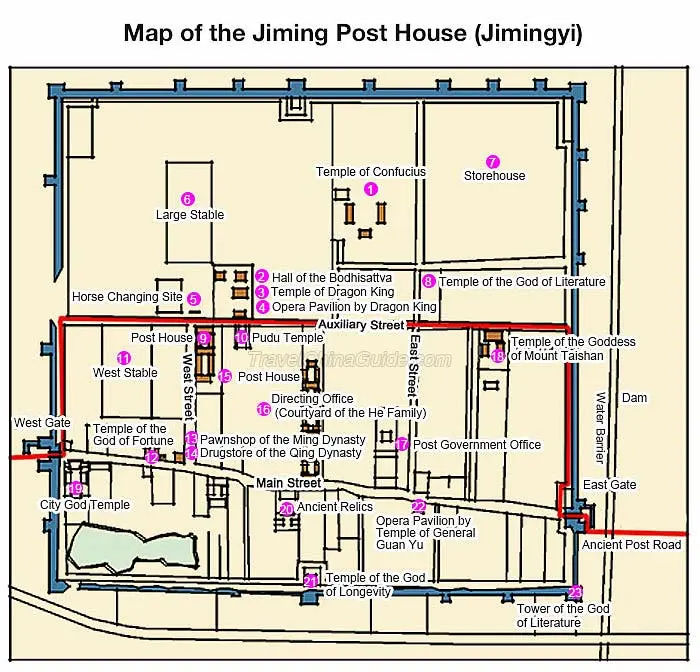
Compound of the He Family of Jiming Courier Station

Some how since coming back from Beijing in 2018 I kept thinking about this place. How the people during the Ming Dynasty lived at Jiming Yi. And I did wish I could write a few fictional stories based on the place. Some how, my research on this place yielded very little. A few days ago I found a nice map.

Now I can imagine the sounds of horse hooves, and the clangs of the watchmen.......But I need more information.

Am glad that Jiming Yi is a good site for film making and documentaries should soon be available....Stay tuned.
Map of Jiming Post House
From China Travel Guide.
鸡鸣驿城

(Also known as the Crowing Post)

In this ancient city, there used to be a He family mansion . The Empress Dowager Cixi (regency: 1861–1908) and Emperor Guangxu (reign: 1875–1908) of the Qing Dynasty put up here temporarily during their westward escape when the 8 Power Allied forces stormed Beijing in 1900.

According to historical records, and with reference to the diagram above, the He Mansion is located right in the middle of the front street, and was originally the seat of the office of a military commander during the Ming Dynasty. Later, the compound was purchased by the He brothers and they renamed it the Compound or Courtyard (Residence)  of the He Family. It remains in good condition today. The compound boasts a large gate with propping eaves featuring delicate tile carving. In front of the gate is a pair of drum-shaped stones facing each other. In the compound, the ground is paved with bluestone. With houses made of black bricks and grey tiles, the compound looks plain and elegant.

Today, four large Chinese characters meaning “embracing great happiness and blessing” written in regular script can be found on the gable wall of the compound's second section. It is said that the four characters were written by Cixi.

The He Mansion has been renovated and sub divided with different functions.


In 1913, with the announcement of the decree of “abolishing courier station and developing postal service” from Beijing, the 600-plus-year-old Jiming Courier Station, which had seen the cavalry of the Yuan Dynasty, the postal carriage of the Ming Dynasty, the battle steed of Emperor Kangxi and the anxious Cixi and Guangxu, faded from people's sight.

April 10, 2020

Soh Mien : Mien Tau or Mien Mui?

Sarawakiana: Foochow Thread Noodles or Mien Sien
Photo from Google.


This long soh mien or wheat thread noodles made by the Foochows in Sibu is usually about 11 feet long. The ends are bigger than the middle parts.

There are two kinds of ends. The usual bigger strands of soh mien are cut to about 9 inches and sold at a cheaper price for those who enjoy a bigger sized and coarser soh mien. This part is called the mien tau, or head of the noodles. Then there are the really end bits which are stuck to the bamboo holders. These are scraped put and dried , usually given free to poorer people or those who wanted some. However some shop keepers sold them at RM1 per packet. Both the mien tau and these rough  ends or cast outs can be cooked for breakfast with a bit of onions, and salt. Mien tou makes good kampua too. When fried with lots of ingredients, mien tou is delicious.

The fine middle parts are preferred by the privileged Foochows. Good soh mien with the best of chicken soup was served when honoured guests came to visit in the olden days. Today most shops sell only mien mui. Mien tou is sold in markets or direct from the producers.

However many shop keepers sell the whole strand of soh mien, meaning, you get both ends and the fine noodles in the middle and the consumer has to dry the noodles and separate them if she likes.

I grew up in a big family and would not ask for the fine soh mien. I had always been alright if I was served with a bowl of the rougher mien tau. Let others have the mien mui.

I am satisfied with whatever is given to me. I don't deserve to eat the fine mien mui. Because I am a girl? or because I am just not choosey.


Sarawakiana: Foochow Thread Noodles or Mien Sien

Here in my cousin's shop in Miri, are bundles of the best of mien mui. Sold at premium prices.


April 9, 2020

Ancient Courier Station of Great Wall of China - Jiming Post

Image may contain: sky and outdoor


the Great Wall of China is a long stretch of all right across the Northern part of China. It was built to protect China and to keep the enemies out of China.

We visited this ancient courier office established probably during the Sptring and Autumn and Warring States Period (700- 220BC). But it was during the Yuan Dynasty (1271-1368) that the first documents were found to describe westward military expeditions and constructions of post road. It was the Yuan Dynasty's emperors' raod to Xanadu and Dadu (present Beijing) via Changping and Huailai.
Courier stations played an important role in Chinese history. In ancient times, posthorses were used to send messages and deliver official documents. Horses had to be refreshed and changed hence many horse posts were set up. They evolved into courier stations where officials and merchants found accomodation. These posts also functioned as military strongholds.
The Chinese word for courier station actually has the word horse on the left side.

This site was badly ruined over time but in recent years, the Chinese government started to renovate it and now it is receiving the largest number of tourists visiting the Great Wall of China.

Established at the foot of the Jiming Mountain, northwest of Huailai county, Hebei Province, this courier station is today a modern tourist site. This was my first visit to Northern China, and Hebei.

According to all the modern accounts, Jiming Courier Station is the best preserved and largest existing courier station in China.

During the Ming Dynasty, the Courier Station was expanded making it the first large scale post house from Xuanhua prefecture to the Capital. In 1570, supervised by Wang Maochang, a defence commander, the bounding wall was constructed with bricks, which was 2,330 metres (m) in circumference, 11.7 m in height, over 400 m in side length and 200,000 square metres in floor area. 

During Emperor Kangxi's reign (1662–1723) of the Qing Dynasty, an assistant officer was designated in charge of the courier station's affairs. A total of 158 soldiers were deployed, including 43 soldiers stationed inside, 45 officers and 49 postal servicemen. The courier station was supplied with 82 horses whose planned annual consumption of fodder was 44 dan (a unit of dry measure for grain, one dan equivalent to 100 litres) and monthly consumption of rice was 493.2 dan. Three thousand two hundred and eighty-seven taels of silver were earmarked for the courier station every year. It was a major transfer station from Beijing to north-west areas.

"Jiming Courier Station city is in the shape of a square. Two gates each with four Chinese
characters on their lintels were separately established at the southern sections of the eastern and western city walls. Military towers were built along the rampart rammed with loess and enveloped with black bricks. Crenels were distributed on top of the rampart. The protruding squarish bench tables were attached to the four corners and outside the rampart. In the middle of the northern rampart the attic of the Jade Emperor (the supreme god in Taoism) was constructed while the attic of the god of longevity was constructed in the middle of the southern rampart. The two attics face each other. Beneath the rampart run the eastern and western passages for post horses to enter the city. South of the city was a trunk road for courier soldiers to transmit orders.
There are two east-west streets in the city connecting eastern and western gates. The southerly street was called the front street while the northerly one was named the back street. Two other south-north roads run in the city. The city is unevenly divided into three zones with nine parts reachable by four paths. A road adjacent to the rampart runs around the city. In ordinary times, the road facilitated the traffic in the city while during wartime, it helped quickly mobilise troops to transport military equipment before they mounted the rampart to guard the city."

It was a robust trade centre to say the least during the Qing Dynasty with workshops, temples, stages and residences of wealthy families.

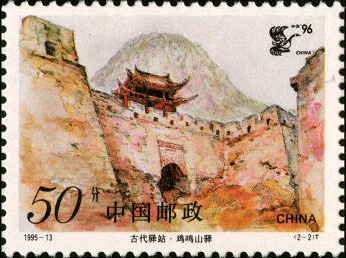
In 1995, the then Ministry of Posts and Telecommunications issued a set of two stamps entitled Ancient Courier Stations. One of the two stamps had a face value of 50 cents and featured Jiming Courier Station.  After the stamp was issued, Jiming Courier Station became famous across the country.Jimingshan Post

Today, the lofty ancient rampart fully mirrors changes in the times. Well-preserved and large in scale, Jiming Courier Station helps later generations get to know the vicissitudes of courier stations, military affairs and development of traffic in China and also plays a part in studying the history of the postal service, architecture, traffic and military affairs and development of China's social economy and religions.

April 8, 2020

Baram Tales : Leaves, Milk and Rice

Image may contain: food
My school mate Elizabeth Chan was a good hockey player and we got along very well in school. She was also in my sister's class and the two were best friends. But fate took all of us apart during the tumultous years of curfew and political changes in Sarawak. She went to teacher training college, in Rajang, my sister went to Batu Lintang Training College in Kuching while I went to MU in KL.

Upon her graduation she married her Kelabit friend, Kallang Akup and went on to teach in many different towns in Sarawak. They finally retired in Bario. All these took 45 years and we finally met.

I went to stay with her in Pa Ukat and she showed me her new culinary skills. She made the fabulous leaf wrapped rice, using the beautiful Kelabit highland Adan rice, milk and the iron tree leaves.
Image may contain: plant, tree, outdoor and nature
Kallang told us that the iron wood tree is easily found in Bario and especially Pa Ukat. His people cut the twigs and plant them around their homes acting as demarcation lines for their property and in no time, the twigs grow into trees and the leaves provide the people with wrappers for their rice.

The dumpling was really good and I ate 2 , while my friend also helped herself to two.

It was the first time I ever ate a dumpling made from highland rice, milk and salt, and wrapped in the fragrant iron wood tree leaves.

Elizabeth has truly acquired many skills in life. Today she is a true farmer in the Kelabit Highlands. And God has blessed her and Kallang mightily.

The Methodist School, Sibu has produced a very outstanding student, educator, practising Christian and personality in Elizabeth. So proud to be your life long friend.


April 7, 2020

Baram Tales : Cinnamon

Image may contain: outdoor
This tree belogs to the family of my friend Elizabeth Chan who is married to Kallang Akup of Pa Ukat. Their farm has many cinnamon trees of this age. Friends who come to visit them get a slice of cinnamon to bring home as sourvenir.

This is the Chinese cinnamon. It is not the same as the Ceylon cinnamon which is cinnamomum verum,often called the true cinnamon.

Winter Warming Spices - Cinnamon, Star Anise. Stock Photo, Picture ...
A lot of this cinnamon is grown in Bario and the surrounding villages, most probably brought over from Kalimantan half a century ago.

Today the Kelabits harvest the cinnamon and sell them at premium prices in airports, and special outlets all over Sarawak, and even Kuala Lumpur.

Cinnamon can be added to coffee, tea and milo besides to curries, and other Asian dishes. Most importantly it is part of the 5 spice combination used by Fujian people in their every day cooking.

Some people believe that it may help in fighting cancer. Studies are being made.

April 6, 2020

Family : Preserved Radish

Image may contain: food


In the 1950's preserved radish were imported by the vendors in Sibu in large ceramic urns. And the radish cuts in those urns were big, probably the producers cut large radishes into quarters and had them dried in the sun and pickled in the large urns.

These preserved radishes were bought in fairly large amounts, in katis and carried in paper bags, tied with grass straws. And housewives when preparing a meal, would chopped them up and have them washed ad then fried, sometimes with eggs.

A dish of chopped preserved radish with another dish of fried peanuts could be the only dishes on the table with porrdige or white fluffy rice.

For my grandmother, uncle and aunt in Nang Chong, porridge was the main staple for morning and evening meals. This was considered very frugal meals and would stretch the proverbial dollar.


Many Foochow women would say that they were so poor that they did not see MONEY. That was their way of expressing themselves. For many, they would "see some money" when their rubber sheets were sold after the smoking of their rubber sheets.

The smoking of rubber sheets was done in a cooperative method. Rubber sheets were sent to the smoke house, usually by the river bank. My grandmother and third uncle owned a rubber smoke house and many families would send their rubber sheets to them.

The smoked rubber sheets were sold after the smoking process ( of three or four days or may be even more days, until the rubber sheets were beautifully transluscent, the colour of amber),probably every two months or so. If there were too many rainy days, smoking of the rubber sheets could only be carried out after perhaps three months. Those would be lean months. And to perk up family moods, my grandmother and aunt would decide to slaughter a precious duck or chicken. Hence it was very important to have some domesticated animals at home. Poultry was not for every day consumption, but for festivals, birthdays, and confinement. It was important for a family to send a chicken to an elder as a gift when the elder had a birthday or was sick. It was also a good gift when a favour was asked.

And yes, only the head of the family would go to Sibu to sell the smoked rubber sheets, which would most probably be my grandmother, who was a trusted "manager".

Green vegetables were grown and it was often that we saw a lot of kang kong and cangkok manis on the table. Salted fish was another common dish. And of course eggs cooked in different way

April 5, 2020

Foochow Storage Jars

My mother's relatives from her mother side were business people in Sibu. My ngie mah or maternal grandmother came from a Tiong family from Kay rou puoh (Creek Head Area) in Minqing.

Hence I was a little girl, I used to meet many of my grandmother's side of the family. I accompanied  her and my mother to the market and the shops.

( Mum cannot drive as she felt that she could not pass the test in English. She was not good at passing exams she told us. And she never felt the need to drive a car. So we used to walk every where in Sibu town.)

One of her maternal uncles was Tiong Liu Tai, the father of Tiong Tung Ung, who was a few years my senior in the Methodist School. According to the genealogy, my own Tiong family is considered several generations "younger" than theirs. So they were "elders" in the family line up. Grand Uncle (or juk gung) Tiong Liu Tai was a salted fishmonger and we usually could buy the choicest of the salted fish from him. We never would get cheated.

As the salted vegetables and salted eggs were exported from Fujian in jars, many of our relatives used to get their jars from Grand Uncle Tiong. And in those days, they were free.

Fujian was known as a province where pottery and some of the best ceramic wares was produced.

These jars were very useful in the downriver villagers. Image may contain: indoor

My grandmother collected them for several purposes - they were used as

1) rice jars
2) wine jars
3) water jars
4) pickling jars

I liked to look at all them when I was young and imagined myself as an inn keeper selling a lot of wine, and with all those wine jars lining one side of my inn's lobby. In my university days I fared well in the subject of Chinese Ceramics. (My lecturer then was no less than Prof Z. Majeed).

I finally came to own a wine jar.

Much later in life, an aunt called me to her house and she gave me her wine jar. She told me that she had kept that jar , from her Sg. Bidut days and it must have been given to her by Grand Uncle Tiong. It was more than 50 years old then.

Aunt was well known for her wonderful Foochow red wine. She was also a very good cook.

She actually taught me many things, especially wine making and often told me stories of how awesome my grandfather and father were. As a niece to my grandfather, she looked at my grandfather as a hero and my father as a gentleman first cousin. She herself was a humble relative with a heart of gold.

But because of my career and family responsibilities, I never did have the heart to make the red wine.

She had told me that if I became a good wine maker I could earn extra income. If only I had listened to her.

Today, 15 years later from the day she gave me the jar, I still have it and still have not nade a single litre of Foochow red wine.

April 4, 2020

Cleaning School Toilets

1960's - 1990's --- It was mandatory for all students of the Methodist Secondary School to have their turns to clean the school toilets.Image may contain: one or more people

the teachers in charge would get very angry when the toilets were blocked or when dirty things were thrown into the rain water tank. There was once when the Principal even found one bicycle tyre in the concrete water tank built on top of the Girls' Toilet.

It was quite ingenious of the the contractor to construct a concrete water tank above the toilet. This ensured that the toilet would have enough water to flush the bowls and wash the whole little annex.

Each one of the girls washing the toilet had a broom and a bucket. I don't particularly remember given any detergent to use, otherwise I would have remembered the fragrance.

But I do remember the smelly white solution that the school gardener would spray into the bowls.

We just called it Smelly Water.

Reflections : We are now in our 60\s and even 70's and are always appreciative of the moral values learnt. We loved our teachers and our experiences in learning and keeping the school clean and tidy.
The whole school had only 3 gardeners but NO cleaner or janitor.

Today, some primary schools have a whole team (e.g. 10 in number) of cleaners in Miri. Are we spending too much money on the wrong things?

Ferry - Labuan - Limbang - Lawas

  In 1974 I started my teaching career in SMK Limbang. I had completed my degree and diploma of education in 1973. When I asked for a postin...