Showing posts with label Sibu. Show all posts

October 2, 2025

The Jetties along the Igan

 Several jetties are found on the left bank of the Igan. Before the Igan Bridge was built, ferries brought people and motor cycles from Sg. Bidut, Penasu and Bawan Assan, Ensurai, cross the Igan river to Sibu.

Many years ago, when my family wanted to visit relatives in Sg. Bidut, we had to make an appointment with them so that they could pick us up from Kampong Nangka. Today, from Kampong Nangka we can take a fast ferry to several jetties . It is very convenient. The ferries have been in use for many decades.


This is a photo of a big jetty. a double decker motor launch berths at its side to rest for the night.


This is a smaller jetty witgh a ferry on the Igan River. Ferries are the life lines of the people who live along the Igan River. They have to go to work in sibu, earn a living and raise families. Some schools are also built along the Igan River to serve the kampongs. Traditional rice farming and fishing are still being carried out along the river.

August 26, 2023

Trivia : Gucci Bags

 Senior Moments to share with my college mates....


I was never a person who looked at Gucci or "any chi" bags...ahem. I could not recognize big brands any way by my 6th Decade. I had been too busy with career and children. Cooking has been my main chore as a wife and mother. Caring for others has also been important in my marriage as I am married into a communal tribal culture.

With so many C's under my belt, I need no more Gucci, Pucci or any other Chi's.

And I often said to myself and my friends that we have a lot better things to do than to go shopping for the latest Gucci bag,

Fake Gucci bags sold in Malaysia. Photo from Google.


One day I saw a grand lady with a Gucci bag and I did not pay attention to her. She was wearing Birkenstock slip ons too. I did not give her another look, so I just look at the floor and started counting the tiles. We were in a long queue along the Five Foot Way.

Then I noticed a familiar face of a driver. He walked up and down and looked at me, seemingly asking me in telepathy, "You cannot recogise me and the lady boss?"

Ah it then dawned on me, I should have recognized the lady with the Gucci bag.

June 16, 2023

An Old Restaurant in Sibu

T

 One of the oldest restaurants in Sibu was the Syn Choon LKiau, a New Spring Restaurant which was rather popular in the 1960's. Many wedding banquets and memorial (old Rice_ meals were held here. It was favoured especially by down river people (villagers)


For a long time the upstairs or first floor of this restaurant was a good gathering places for down river people as the food was good.


But what was very memorable was that the shop banner has three languages, Chinese in red, English in blue and Jawi also in blue.

A shop sign board in three languages was not very common in those. Bujt correct me if I am wrong.

May 24, 2022

Sibu : Red is Auspicious

 Red is a colour and a favourite colour of most Foochow women. It is an auspicious colour for our culture. It is a colour for weddings, for birth celebration and especially for the Full Moon, or the celebration of of baby's first month of birth. 

There is a joy of sort when a young boy or girl wears red. Red ribbons are always preferred for a little girl's hair. 

But it is also a colour of danger, my friend, a great teaher, reminded me. She said we must look at every thing in its context. I will remember that. And with a pinch of salt too, I would say.

Here is a poem for you to enjoy by Mary O'Neil..


Red is a sunset
Blazing and bright.
Red is feeling brave
With all your might.
Red is a sunburn
A spot on your nose.
Sometimes red, is a red red rose.
Red squiggles out when you cut your hand.
Red is a brick
And the sounds of a band.
Red is hotness
You get inside
When you�re embarrassed
And want to hide.
Fire-cracker, fire-engine
Fire-flicker red �
And when you�re angry
Red runs through your head.
Red is /a chilli/
A Valentine heart,
The trimmings on
A circus cart.
Red is a lipstick
Red is a shout
Red is a signal
That says, �Watch out!�
Red is a great big
Rubber ball.
Red is the giant-est
Colour of all.
Red is a show-off,
No doubt about it �
But can you imagine
Living without it?
Author: Mary O�Neil

Have a great day.

September 5, 2021

Sibu Tales : Hock Ming Road and Wharf

 119A Jalan Kampong Hilir, Sibu

As the kampong grew with increasing population, the Hock Ming wharf saw more and more commuters from as far as Bawang Assan, Bukit Lan and other Chinese villagers on the west bank of the Igan. 

This has been a very interesting access for the Chinese villagers of Sg. Bidut to be able to use the path to the main road called Kampong Hilir Road. Commuters would either use the bus, or private taxi or their own motor bikes to go to Sibu town for work or for some official business.


As
The small concrete path is between two big kampong houses.

A narrow cement path leads from Kampong Hilir Road to the river bank and jetty or small wharf.

Many of the commuters come from the villages as far as Bukit Lan. With motor bikes they can find better income jobs in Sibu and they don't need to depend on agriculture.


Today the ferry is much bigger to accommodate motor bikes and more passengers.

The Hock Ming Road which is on the left bank of the Igan is one of the longest roads in Sibu division. It can reach Tanjong Manis.

This is unique sharing of accessibility in Sarawak which says a lot about racial harmony and love for one's neighbours.
TT

September 2, 2021

Guong Ming School : Jetty and School History


The Guong Ming School Jetty is accessed from Kampong Nangka, on the Sibu bank of the Igan River. This jetty has been in use since the early 1900's. In the early settlement days, Sg. Bidut Foochows rowed their small boats to Kampong Nangka and from there they walked to Sibu town.

They could also row their boats to the Lau King Howe hospital jetty, slightly more than half an hour of slow paddling up the Igan, to the confluence where the mighty Rajang meets the Igan, fairly near the hospital jetty. In those days the two rivers seemed to be huge and unconquerable. Big ocean going ships like the Auby and Soon Bee docked near the hospital at the Government Wharf.

The rubber growing brought a lot of wealth to both the Chinese and indigenous people in these two valleys.

With the growing prosperity, the Foochow pioneers thought about education for the next generation. Thus when the Guong Ming School in Sg. Bidut was established by 1930's more and more motor boats and motor launches plied along the Igan River. Better outboard engines became popular while paddle boats were still used by the villagers.

By the 1960's there were more villagers who worked in Sibu and Guong Ming School jetty became a landing point for many of the commuters from Sg. Bidut.

These three photos are from Alice Ong Sebastian, who kindly took them for this blog post. They show the Sibu side of the Guong Mig Jetty.


The ferry can take many motor bikes across the Igan River. Cars however have to use the Igan Bridge which spans from a point in the Sg. Merah vicinity to the west bank of the Igan below Sg. Bidut. The bridge was completed not too long ago.


Below is a translation from the Chinese, a short history of the Guong (Kwong) Ming Primary and Secondary Schools.

In the early 20th century, Ming Ching, Kutien, Ping Nang and Nang Ping Foochows arrived in Sibu and settled down on the west bank of the Igan River which was totally uninhabited in those days. By 1930, the population increased and the community leaders decided to establish a school. In 1932, Tiong Kung Nguong, Wong Ing Gui, Tiong Kung Kiing, Sia Dieu Mook and Yong King Pang founded Guong Ming School for pupils who were of school going age.

In 1951 the elders also decided to establish a secondary school. Yong Ung Chai was instrumental in this endeavour. Thus in 1952, when the school year started, the secondary school, also named Guong Ming was formally opened. In 1958, the school buildings were declared opened.

In 1961, Guong Ming school faced serious competition because it was a Chinese school. But fortunately Soon Choon Foo , a Nanyang graduate was made the Principal. And with his help, and the help of members of Board of Directors like Tiong Yong Chiong, Su Kie Yew etc, started the senior middle classes. By 1977 school alumni was established by Ling Sie Ming which helped the school in various ways.
In 1989, School Chairman, Huang Puoi Ngiu, and later in 1990, Chairman Lau Hui Kang, helped to put up 2 more school buildings at the cost of RM1.4 million.
In 1995, under the chairmanship of Tiong Tai King, a big hall, named Tiong Ung King Hall was erected and was completed in 2002 at the cost of RM 2.0 million. The school was completely modernized.


October 12, 2020

Chop Poh Guan


Ting Ung Kee was an energetic Foochow man who was determined to do the best he could in Sibu.

He was born in Kutien and had married into a Chinese physician family. He memorized Chinese classics thoroughly according to a relative to impress his father in law who finally took him under his wings and taught him all he knew about Chinese medicine.

After he had a son, he decided to move to Sibu, then called New Foochow to seek his fortune. It was also during the war years in the 40's that he started a small shop called Poh Guan in Old Street. He even paddled a small boat selling Chinese medicine up to Ulu Balleh. He was unafraid of any dangers. When peace came he had established himself and soon his little half shop flourished. 

He had many medical formulae which made him famous like Sing Gong Chui, Minyak Cap Rusa (for massage) etc. Poh Guan became a good place where people of all races stop by to buy medication. Foochows from all over the Rajang Valley would stop by to see the friendly and wise sin seh for some herbs and quick fixes.

Today, if you are a Foochow you would definitely have a bottle of Sing Gong Chui in your medicine cabinet. I do..and I won't leave home without a bottle or two, may be even half a dozen.

January 10, 2020

University Motto : Nanjing University, China.

 I am interested in learning more about mottos of educational institutions. So from time to time, I will google and put one on my blog. Today it is my favourite Form One Science Teacher's University. The Nanjing Unversity of China.

Mrs Chih Mei Xi taught us in 1962. She was a very fine and upright woman who exuded discipline and fine behavioural traits. 

Motto


Officially translated into English as "Sincerity with Aspiration, Perseverance and Integrity". Another version is "Be Honest and Intelligent, Study Hard and Act Sincerely."(simplified Chinese: 诚朴雄伟 励学敦行; traditional Chinese: 誠樸雄偉 勵學敦行; pinyin: chéng pǔ xióng wěi lì xué dūn xíng)

The first half of this motto was the motto during the National Central University time, and the last half was quoted from the classic literature work Book of Rites. It was voted to be the motto by university students in 2002, and the then university president supported it and wrote an article to interpret it.[20]

The translation does not fully express the meaning of the Chinese words of the motto. Motto counterparts between Chinese and English literally: Cheng (诚, Sincerity, Honesty, Integrity), Pu (樸, Simplicity, Austerity, naturally being oneself), Xiong (雄, Sturdiness, Majesty, being vigorous and keeping ideal and ambition, being firm and persistent with fortitude), Wei (偉, Greatness, having great ideal and ambition, with great mind comprehending, containing and improving world), Li Xue (勵學, Endeavor to Learn), Dun Xing (敦行, Urge to Act, Act Sincerely). The term Dun Xing comes from the context in Book of Rites: Having broad knowledge and strong learning ability and being modest, acting in sincerity and benignity and not slack, that is a gentleman (gentleperson) (博聞強識而讓 敦善行而不怠 謂之君子).

(Source : Wikipedia)

September 26, 2019

The Corporate Will of 16 Foochow Men and their Progressive Outlook

An Exceptional Foochow Kongsi


16 Foochow men including Lee Chung Tiong ;Lee Chung Kwong; Wong Sui Sieng and Hii Kah Piew formed a company to start a corporate rubber development area.Image may contain: 1 person

The company started in 1920's with the blessing of the Methodist Mission under Rev James Hoover and the Bishop Oldham. The area selected was 12 miles from Sibu on the western bank of the Rajang below a little stream called Sg. Pan. Opposite this chosen area is Lebaan or Lo Ma Ang.

Today one of the longest bridges across the mighty Rajang starts at Lebaan. (Ref: Wong Meng Lei)

Wong Meng Lei attributed the positive impetus which caused the rapid development of the area as:

1. The land was granted by the Rajah who agreed that it was time for the expanding Foochow population to move out of their original land in the vicinity of Sibu. With this official recognition the Foochow settlers was guarranteed security and peace from the surrounding indigenous people. Besides the presence of Rev James Hoover as a "protector of the Foochows in their development endeavours" and a "voice to help them" were very important success factors. The Reverend James Hoover had indeed the "ear" of the Rajah.

2. Besides starting a farming area they also contributed money to build a Methodist Church called Poh Hie Church and a primary school called Kai Hua Primary School. The presence of a Methodist Church and a Methodist based school also promoted social well being and a God fearing community. The farmers settled down to good work while the children were able to grow in wholesome environment like in any rural part of the United States of America or England. Honesty and accountability (and I think at that time transparency was apparent even though the word was not in mode then) were important factors which contributed to a successful management.

3. The group of Foochow men who formed the company were kindred spirits who maintained relationships akined to that of blood brothers in the traiditional Chinese culture. They were neighbourly and God fearing. They shared their wealth and advised each other in investment. Their families looked out for each other in ev ery sense of the word. In fact many of the younger generation spoke of these elders as "elders who helped them reach the shores of prosperity" (Keng shurn nyiang) . The following names are the original homestead owners of this area by 1950 numbering 63 . Their houses were still standing in 1970 but after that period most of the houses were abandoned.

4. An outstanding feature of the area was the Godly presence which the group upheld. The Church Poh Hie Tong and the school Kai Hua Primary School were the first buildings to be seen whenever any one alighted from a motor launch at the jetty. The homesteads were all built along the road behind the church and other smaller roads which branch out from the main road.

5. Rubber was an excellent crop selected at the right time and at the right place. Without rubber as a cash crop this area would not have prospered so miraculously.

6. Welfare and well being for all - together moving forward with all their hardwork put together in spite of their initial suffering. Their ability to meet changes and challenges helped them prosper. Their future oriented outlook and their Foochow energy were really their mainstay in their visionary effort. It was the will of these Foochow families which helped them prosper in the long run. At first it was definitely difficult and up hill in clearing of the mosquito infested land with flooding every day. But towards the end of three years they saw their rubber trees growing and they were filled with gratitude and satisfaction that God had indeed been with them.

Lee Chung Tiong
Lee Chung Kwong
Wong Sieng Sui
Lee Tiu Huat
Hii Puo Hoh
Yek Chew Ching
Tiong Chiong Hook
Hii Puo Kiong
Hii Puo Chiong
Hii Chai Sieng
Hii Kah Hii
Hii Yii Tiing
Hii King Chuong
Lee Tiew Lieng
(to be filled later)

End Notes:

Kai Hua Primary School was started in 1937 after the founders (Yuan Chiang Wei- Wong Too Liang- Hii Teng Shii- Hii Kah Chow -Hii Kah Piew Lee- Choong Kwong and Hii Kah Kai and others) raised enough money. Wong Too Liang was the first Headmaster and pastor in charge. Before 1937 the children from this area had to row their sampans to stdy in Tung Kwong Primary School. Hii Kah Piew the father of Datuk Hii Yii Peng was the first Chairman of the School board. In 1939 Lee Chung Tiong becamse the Chairman of the School Board.

The last Headmaster of the school was Ling Kwong Hee who arrived in May 1979 and left at the end of 1984. He stayed at the school boarding house which had not electricity and water supply. He cooked for himself and taught only 12 students. By that time only four or five families remained. All the rest had moved away.

The school had to close and that concluded the special era of a corporate farm in the Rajang which spanned 75 years!!

-------------------------------------------------------------------------------------
Notes : My sincere apologies to all the elders whose names in English might have been wrongly spelt by me. I do hope that one day I will get all the names spelt according to their birth certificates or obtain the correct spelling from their descendants.

On a further note we must realise that names in Chinese are spelt in different ways according to dialects. A Kutien man whose name is Ling Berng Hui may be called Ling Bang Hooi in Hokkien. My father's Ming Ching name Tiong Poh King was Teong Por Keing in Putien.

So there is a lot of confusion in spelling and the registrars of births in Sarawak often have trouble when they have to record births.

b. Even thoujgh Rajang Basin and many of us can easily draw our conclusions why a beautiful area like this can be abandoned in the 70's. But who knows if there is such as thing as hope against hope 16 Company can be rejuvenated ?

September 20, 2019

Shop houses of Sibu's Channel Road

No photo description available.
Photo by Sarawakiana : Channel Road at Night.


The Brooke administration built the Sibu Fort along Channel Road in Sibu according to written history. Thus it can be concluded that the road  is the first  ever built in Sibu in 1862.

A small Chinese bazaar started by merchants who came to trade in the middle valley of the Rajang River soon grew, clustering around the Fort.

On May 13 1870 a group of Ibans under Lintong tried to attack the Sibu Fort. A year later, the Sarawak Gazette reported that there were 60 wooden shops in Sibu. In 1873, the Sibu Division was created by the Rajah and Sibu town was officially included.

The first traders were Teochew, Minnang and Hakka people. They were followed by the Cantonese and the Foochows and much later the Hin Hua People.

No photo description available.
Old photo of Channel Road, facing the Rajang River.
The original towkays (before the arrival of the Foochows) therefore owned probably the entire row of shop houses along the Channel Road.

In 1893  Munan anak Minggat and his followers arrived in Sibu. He had found Sibu a thriving bazaar and decided to build a longhouse at Pulau Kerto opposite Sibu.

As a loyal war leader to the Brooke Government, he had helped to suppress Iban rebels in Upper Katibas and Lupar rivers in 1860's and 1880's. In 1903, he was the first Iban to establish a rubber plantation in Kuching. He used his wealth from rubber to buy shop houses and land in Sibu.

On 10th February 1889, Sibu Town was razed to the ground. On March 8th 1928, Sibu was again ravaged by fire.

All the wooden shophouses were burnt and slowly concrete ones took their place. If one could look closely, the years of the shop houses were built could be seen on the facade.

Many of the shophouses along the Channel Road were were built in the colonial style, two storeys only and about 120 deep and 60 feet wide. Moreover many of the shop facades look like those shop buildings of Singapore, Malacca and Penang.

The Five Foot Way is wider in the traditional shophouses is higher above the road.

Note : Much literature can be found about the five foot way or Kaki Lima after Sir Stamford Raffles designed and planned the Singapore "entrepot". The term Ngo Ka Ki (five foot walkway) may have been coined by builders in response to the minimum width of the walk way. "The walkway became an integral feature of Malay Peninsular and in the later half of the 19th century, a feature of the Straits Settlement Style buildings."


June 10, 2019

Old Sibu Silversmiths

My maternal grandmother had one precious silver hairpin which she brought from China. It was probably given to her by a Lau relative later in life. She wore a silver ring which helped her in home treatments of fever. As she was a child bride she did not bring any jewellery from her Tiong family.

Throughout her life she did not buy much silver ornaments. However she visited goldsmiths to buy gold ornaments as wedding gifts and a few silver bracelets and anklets for babies.

But she and I made the rounds of visiting silversmiths and goldsmiths in Sibu. Ah all those glittering ornaments stay in my mind.

Her most precious gold ornaments which never left her body were her gold earrings and her gold bangle (which she later endowed to her third daughter in law, Wong Nguk Ling). She was not a jade bracelet wearer.


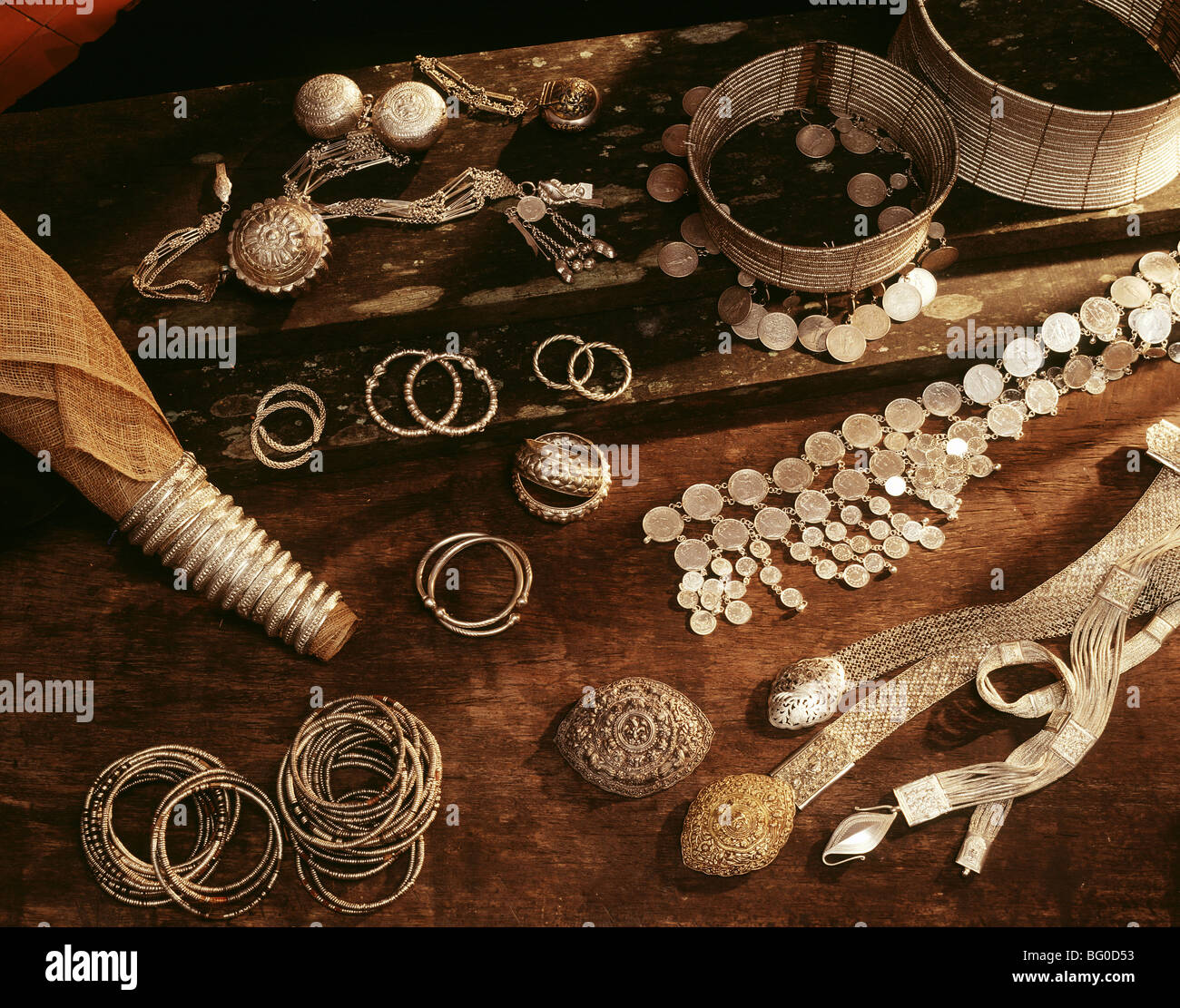
Silver was a valuable possession to the Ibans and other ethnic groups of Sarawak. In particular the Ibans bought a lot of silver jewellery for their women. Iban women's head dress, necklaces, and belts and other ornaments were all traditionally silver. But unfortunately over the last half century many longhouses were burnt and almost all their silver ornaments were melted by the various fires. I know of a few families who lost thousands of ringgits worth of silverware and gold in the longhouse fires. It is a great pity that such valuable antiques should be lost in this way.

Thefts too have caused many Iban families to lose their valuables.

When times were good many Iban men and women would approach the silversmiths of Sibu to make special items for them. Sugu Tinggi (Maiden's Head gear), rawai (silver corset) and silver belts are among some of the favourite items the Chinese silversmith could patiently make. Thus the Chinese silversmiths did a roaring trade before the 1960's. Many of the silvermiths' shops were along Channel Road, easily accessible to the Ibans who came down from Kapit, Song and Kanowit, or from down river from Bawang Assan.

Some of the old shops along Channel Road, sold both silver and gold ornaments like Mee Hua,Tien Hua (Chung family) Ing Hua and Teck Ho.


Examples of precious Silver items:

a) Special silver belt

b) special silver belt and buckle

c) Iban corsets or rawai and other silver ornaments
Image result for Iban silver ware

But alas, today their business is on the decline due to many economic and social factors.

(Photos from Google)


June 9, 2019

old kwong lee bank

.
The photo from Chua Chong Hian of Sibu shows Kwong Lee Bank flying the Union Jack. this photo could have been taken during a special occasion, probably the visit of the Duchess of Kent, in 1952. Or it was taken during the Queen's coronation in 1953.


Image may contain: one or more people and outdoor


Do you know why Bank Road was called Bank Road?

It is one of the shortest roads in Sibu. But it used to have two banks, the Kwong Lee Bank and the Wah Tat Bank.


Kwong Lee Bank which was founded in Kuching, in 1905, opened its first branch in Sibu in 1932. It must have been the first bank in Sibu as Wah Tat Bank and Hock Bank came later. 1929 to 1933 were Depression years and Sibu people suffered  and were in financial difficulties.

Kwong Lee Bank opened its second branch in Sarawak in 1937 - in SArikei.

Its third branch in SArawak was in Bintangor, but it was only in 1978

(NB the Bank Guard was a Sikh.)

May 1, 2015

Kitchen Talk #1 : Tailors and Tailor Made clothes

Kitchen Talk #1 .


Very 60's - 70's : "Who made your clothes?" This should be complimentary to the person addressed, and it should be taken as a compliment from a person who is keen to look as good as you.


However it really depends on how the conversation goes... However some people do not want to disclose where they had made their clothes and would not share tailor...

.
Photos: My aunt made her own clohtes(right) Studio photo. Left : Empire waist line ( My beautiful tailor/seamstress, Angela Wong of Rajang Park, made some of these for me when I went to study in Kuala Lumpur, early 70;s. I am forever grateful to her and her great wisdom. Angela would always entertain other friends..This was her great genuine kindness...


A few words about the Empire Waist Line

http://upload.wikimedia.org/wikipedia/commons/thumb/4/4b/Dancing-Dress-1809.jpg/190px-Dancing-Dress-1809.jpg
 Empire is a style in women's clothing in which the dress has a fitted bodice ending just below the bust, giving a high-waisted appearance, and a gathered skirt which is long and loosely fitting but skims the body rather than being supported by voluminous petticoats. The outline is especially flattering to pear shapes wishing to disguise the stomach area or emphasize the bust. The shape of the dress also helps to lengthen the body's appearance.

The Empire waist line has come back to high fastion.


February 4, 2015

Sibu : Horse Tickets and Sarawak Turf Club

Sibu had a Race Course Road but some thirty years ago, it was renamed Jalan Awang Ramli Amit . However the locals continued to call the road by the former name for many years. I am sure the older people still think of the road as Race Course Road, in English and Pou Mah Duo in Foochow.

And I used to wonder if there was ever a real race course there. However my guess is after the First Rajah, James Brooke built the fort (Fort Brooke), he named the road from the fort to Sibu bazaar, Race Course Road.

Charkes Brooke being a keen horse man and a horse racer, probably also hoped that Sibu would prosper and horses would be reared by the local Chinese and Malay population. He enjoyed horse riding and had lost an eye during one of his riding excursions in England.

However, the Kuching Turf Club was only established after his death, in 1924.

The prospects of horse racing in Sibu were not that good. But some how the name got stuck.

Having said all that, in actual fact, the Sarawak Radio in the 50's and 60's used to broadcast the races and men would be glued to the radio to listen to the results. It was quite interesting to listen to the radio commentators who were really good over the radio. At times I wonder how those not educated in English would understand the English commentators. I suppose they just enjoyed the tones of the excitement in the voice of the commentator.


Anyway, one of my favourite memories of Horse Racing was related to the Singh who sold lottery tickets to every one in Sibu and especially to my father. He would come around the coffee shop and when he saw my father, he would say, "Mr.Chang, win, win win..."

He was a very pleasant man and most people would buy from him, two at least at one time. I suppose buying two would increase the chances of winning.

Some how I always associated horse racing with this Mr. Singh. My father never won any lottery and towards the last years of his life,he lived a very low profile life, preferring to read, doodle, and draw with an art pencil.

And he also said that he had to avoid Mr. Singh!! We thought it was quite easy because it was easy to see Mr. Singh from a distance in the small town of Sibu. It was quite humourous actually.


No photo description available.
But being young I did not understand anything about horse racing, the Sarawak Turf Club in Kuching, etc.. And I did not know that it was a kind of gambling.

Lottery tickets are called "Horse Tickets" in Foochow.

Today many Chinese calendars still print the horse racing days (Ipoh, KL,etc)

December 11, 2014

Christmas Message from Rev and Mrs.Lionel Muthiah


   Christmas 2014

“ Stir up our hearts , O Lord, to make ready the way of your only Son, so that by his coming we may be enabled to serve you with pure minds, through your Son,  Jesus Christ our Lord, who lives and reigns with you and the Holy Spirit, One God, world without end. Amen.                         (Service Book and Hymnal, 75, adapted)

           “Are we there yet?” “Is it Christmas yet? No. It is Advent. What is that? So, some of us who follow the Liturgical calendar have to educate, interpret and explain biblical history. However, we know you would rather have news about us! Marion and I are doing well except for the usual aging issues.

            This year we were able to attend three High School graduations---Micah Coffey in Batavia, IL. He has been accepted by the University of Minnesota and given academic and baseball scholarships. Jacob Helton of Franklin, TN decided to take a year off (although was accepted by a couple of Universities) to work for a while on the Unkenholz family farm, where Marion grew up,  and to help neighbors with “fix it” jobs. Then we went on to Pasadena, CA to attend Samuel Muthiah's graduation. He was accepted by Westmont University, Santa Barbara, CA and given a four year scholarship.

            By doing this Marion and I missed two College graduations----Jordan Coffey from Taylor University and Sarah Helton from Union University.

            After working as a Nanny during the summer, Sarah went off to Kenya, Uganda and then Malaysia (lots of relatives) where Sarah’s mother, Lora, joined her. Together they flew to Singapore. After visiting more relatives, Lora flew back to Tennessee. Sarah then went on to Australia, New Zealand, and Hawaii. She visited her Uncle Rob and family in Altadena, CA and brother Josh and wife, Jessica, in Morrow Bay, CA. She came to visit her Uncle Rick and family and us in Newberg, OR. What an adventure for a young lady!

             We have some travel plans for the New Year and trust they will work out.  We’ll report next year!
                                         

            We continue to be grateful for our Friendsview Retirement Community where we have lived since August, 2009. It has been said that sometimes God leads us where we did not plan to go! God has indeed surprised us in many ways!

May your life also be filled with God's surprises! Create a
        Merry Christmas and have a joyous New Year.

Marion and Lionel Muthiah, 1015 Cherry St. #7, Newberg, OR 97132  Tel. 971-832-8533

July 4, 2013

Old Sibu - Fire and the aftermath in 1928


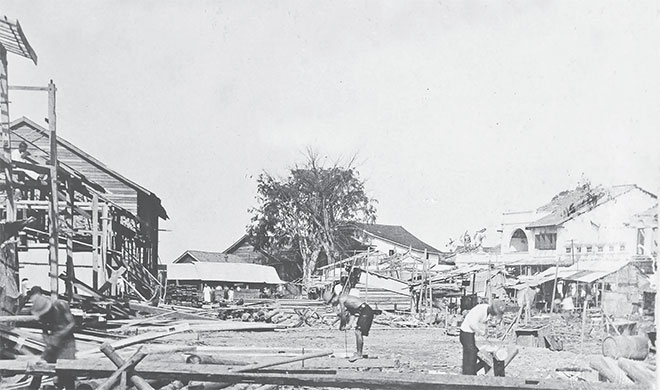
The 1928 fire of Sibu was a real tragedy. This is the back lane of the Old Street after the big fire.
The captured scene shows the aft ermath of the ‘Great Fire of Sibu’ in 1928. All features as seen on this photo are gone, except for the tree at the centre and the concrete block on the right. The raintree in front of Tua Pek Kong Temple is now the oldest tree in Sibu Central Business District. Tua Pek Kong Temple was also rebuilt.

Here is another photo of the aftermath of the fire in 1928


After the fire of 1928, the first block of concrete shophouses were built, Old Street.

My father was 18 years old at that time and he was getting ready to go to study outside Sibu with his two younger brothers. My grandmother had also just passed away.

My grandfather had made some money (1914-1920 great rubber prices) for the family through his rubber gardens and wanted his sons like other rubber planters' sons to study in Singapore and then in Shanghai and even Beijing if they could qualify. The fire most probably dampened the spirits of many Foochow families.

Another rubber planting family, the Wong family from Sungei Merah was also planning to do the same. Strangely, Mrs. Wong was unable to sleep two nights before the fire according to a family story. So the morning before the fire, she walked all the three miles to Sibu and took her cash from the Hock Chu Huo, or Mr. Wong King Huo.

She took out all her cash, put it in a flour bag and walked all the way home. That night she was able to sleep really well. When she woke up, she went about her chores, only later to be told that Sibu had been razed by a huge fire.

Note : My grand uncle Headman Lau Kah Tii and Rev James Hoover were also quite helpful in introducing the Foochow boys to study in Chritian schools in Singapore and China. Mrs. Wong's sons all went to university in China and Hong Kong.

Ferry - Labuan - Limbang - Lawas

  In 1974 I started my teaching career in SMK Limbang. I had completed my degree and diploma of education in 1973. When I asked for a postin...