Showing posts with label Sibu Tales. Culture. Show all posts

August 29, 2022

Sibu Tales : the Kompia Revolution


 Most westerners would know bagels as a good carbo ridden food which make people feel good and very full. Most western bakeries sell bagels.


The Foochows have their famous bagel like bread called Kompia which is very tasty and it is always made in the early morning for the breakfast crowd.

Wan Hin in Sibu was the first bakery I knew as a kompia producer. They had an charcoal oven which was like an upside down tandoor. In fact if you looked closely it was a big vase with charcoal at the bottom. The round bread was stuck to the wall of the vase and baked. sometimes a fan was used to control the fire.

Kompia will usually be made with or without sesame seeds/

My photo shows kompia with sesame seeds. The bread is sliced so that a delicious minced pork filling can be used ...it is a lovely Foochow sandwich. To die for. And it must be eaten hot.

Today kompia can be found all over the world where Foochows are found, especially if the Foochow bakers can get the traditional recipe from fujian or Sibu....In Malaysia kompia has even been made by Muslim bakers!!

January 13, 2022

Sibu Tales : Chinese Lunar Calendars


Every year when November came in the 20th century when my Grandmother was still alive, we children would be so enthusiastic  going around the shops in Sibu to ask for free Chinese Lunar Calendars to bring to Nang Chong, so that my two uncles, Pang Ping and Pang Sing, and my grandmother could decorate their walls with a few of the cheerful Calendars.

The villagers would come and admire the display of Chinese calendars on the wall. And we would be so proud of the house.

some families could only get one because they had very little connection with the shopkeepers in town. I still remember my grandmother would certainly get one from Tiong Ching Hing (a kawan shop and a relative), Chop Choo Seng, and Poh Nguong,while my family would definitely receive a complimentary one from Ching Chiong, a shop belonging to the Sia family. Mum would get one from Chai Hong (our sundry supplier), Wen Hua (Uncle's book shop) and Hua Ing (another uncle's bookshop). Later, when a foster aunt worked for See Hua, we would also get a free calendar or two from her. It was our family pride to be able to give away a few to others who needed one.

Today, we would say to the recipient of these free calendars, " To bless you...." If only there are some rural villagers now we might be able to bless them with calendars we can buy in shops JUST for OLD time's sake.

My grandmother would enjoy tearing a sheet of the calendar each day and she would look forward to the birthdays of her children and grand children. She had a great brain, every birthday was in her memory. She probably did not have to dog ear the calendar sheets to remind her.

It was always good for Grandma and I to tear the black sheet for Saturday....and she would know that we have come to a Sunday. You see Sundays are in red as in the photo. Other days in black. My grandma, you see, was illiterate. So the colour coding was good for her. 

These days we have to buy our Chinese Calendars if we need one. Few businesses have the budget to print many and therefore they have to be very selective when they give out their calendars.

January 10, 2022

Gifts to the Bride : Sewing Machine

The Foochow bride in the 1950's would arrive at the bride groom's house with some bridal gifts which came in odd numbers, 3,5.7 or 9. They were carried by bamboo poles and would have been paraded around the town in the bridal procession, or bridal car, brass band and all. It was a grand procession if the families were rich and famous. Fire crackers would be fired to add to the merriment. Every one would come out of their homes and shops to the street to watch the parade.

As kids we were very excited to watch this exciting event!!

The most important gift desired by a daughter was a sewing machine. She would look forward to a Singer Machine as she had contributed a lot to her family as she grew up.

Girls had to rear domestic animals, wash clothes, tap rubber. And they would have been given any pocket money. So the hardworking girl would be given more bridal gifts than a lazier one. When my cousin was about to be married, at the early age of 19, my uncle and aunty had to scraped some money together to buy her a good set of bridal gifts.

According to relatives, they even had to borrow some money for exigencies, in case the wedding feast cost more, although it was held at home and all domestic anmials and especially the pigs were raised by themselves.

My dear cousin Lau Kiing Huong was given a good set of bridal gifts and her most treasured gift which


After her wedding, she lived in Sg. Bidut with her in laws and her husband had 11 silbings.

It was her duty as the eldest daughter in law to make clothes for them, especially for the Chinese New Year. Her mother in law would buy the materials and she would make many clothes for her in laws, especially the children. She would do all her household chores before she could sit down and rest a bit. The she would be sewig away.

One of her favorite sewing activities was the making of patchwork quilts.

All her baby clothes were sewn by her because in those days, no good mother would spend money to buy ready made clothes.

Her mother in law told her,"Make the clothes yourself for the children, they would last longer and no matter how much you wash the clothes, they would not be worn out. And indeed a lot of people would seek her out, to ask her to use her sewing machine to do some patching of worn clothes. Rural villagers were very frugal. Nothing was wasted, even if the clothes were a bit torn and worn out."
she loved till she passed away two years ago. She had loved her sewing machine.

In those days, it was common to refer to a daughter's marriage as a "sale". A father might even say, "I have sold off my eldest daughter." Though crude and even impolite, we Foochow girls accepted the unpolitically correct term as a matter of fact.

Yes, when time came for us to be married, we were sold off. Some parents made a killing, others made a loss. 

People in those days believed in fate.

January 7, 2022

Sibu Tales : Reporting of Births

 The Year of the Tiger


Many parents who had baby girls born in the year of the Tiger, for example 1938 and 1950, and 1962, in Sibu especially  would deliberately register their births either a year earlier or a year later by late registration of birth. 

This registration of birth would later be of an advantage to them because they did not want to face problems of having to marry their daughters off as Tiger Brides. If the birth registered a year earlier, the baby would be an Ox, or a year later, the baby would be a dragon.

Peng Li Yuen - First Lady of China, wife of Xi Jin Ping.

Many match makers would not like to make a match if they knew that the girl was born in the year of the tiger. So it was very convenient if the Tiger Girl had a birth certificate which would camouflage her zodiac  animal.

Tiger brides were most feared by Chinese families as they superstitiously believed in those days that the tiger brides were fierce, could cause ill fortune (the husband would die at a young age), and would bully every one in the family. The first thing a potential mother in law would ask a match maker was what was the zodiac animal of the girl she was introducing.

Today many social changes have come about. Girls have become more educated, parents are more open minded. Match making would be a t hing of the past. And many marriages are furthermore bi racial. There are lots of choices now. So it wont be necessary to register the birth later.

According to a modern Feng Shui master, people born in the year of the Tiger are actually born leaders and managers. They are often found as top people in the four most important fields of the society e.g. politics, literature and arts, finance and economics.

It is good that in the 21st century the Chinese people are no longer superstitious and do not believe in all the beliefs related to the zodiac and other kinds of fortune telling.

Peng Li Yuen is the present first lady of China. She was born in the year of the tiger. There are other great examples too.

December 17, 2021

Christmas Trees of Sibu Parade - Kampua Christmas Tree

 Every year in December, a night would be chosen for a Christian Chrismas Parade in the past.

The Parade would have almost all the churches and associations coming together to show case their creativity and enthusiasm to celebrate the Birth of Christ. There are many Christian denominations in Sibu as well as diverse racial groups which are Christian. So the parade would be very colourful, interesting and huge!!


In 2016, this Christmas tree was made to represent noodles!! It was very memorable and representative of Sibu which has always been famous for Kampua.

September 23, 2021

Sibu : Did the Placenta turn inside out?

 The birth story of a lovely girl with big eyes and a mop of hair.

This is also the story of a very concerned mother who was kind of disappointed that her daughter had given birth to a third baby girl. A kind Foochow midwife would totally understand the disappointment.

And the age old belief of reading the placenta was once again brought to the forefront. Please Read on.....


We have been living in Sibu, a dominantly Foochow town for some years by then when a third child was expected. People had started asking me if I had looked forward to a boy. I replied I only wanted a healthy child, and a boy or a girl would be welcome.

Sadly , my mother in law was suffering from breast cancer and had been seen at the Lau King Howe Hospital and by our favourite practitioner, Dr. Fan. The prognosis was not good at all. She could go any time.
Usually for busy ASIAN fathers, any childbirth would be in the hands of the expectant mother. And child birth in most cultures is no big deal. In Sarawak, the Penan mother had in the past gone into the jungle to deliver her own child, without any one in attendance. Among the hardy Foochow pioneers many women carrying their babies full term gave birth in the rubber garden while taping rubber, cut the umbilical cord with a broken latex bowl and went home as if nothing happened.
It was a school day and the baby was not due until the end of the month. But it decided to come in the middle of a Sixth Form British Constitution lesson. Luckily it was not dramatic. So off I went, quietly to the maternity clinic with the help of my colleague after giving all the instructions to the school clerk and my departmental colleagues. The school clerk would process my leave and arrangements would be made for the marking of examination papers and sit ins.
The private clinic midwives were good especially my aunt Lau Fong Fei, who informed my mother and sisters about the impending birth, which could be any time in the evening. The labour pains started nonetheless. There was no recess time for labour pains.
The whole maternity ward, well air conditioned, a luxury at that time, was empty except for myself, as the other bed was vacant. It was a bit frightening but I could hear people walking and sounds of babies crying. I could even hear new mothers being discharged from an outer office, all in Foochow of course. Giving birth in a maternity clinic was a luxury not many women could afford and it was also for a mother who was certain that there would be no complications.
Then it was time for me to be wheeled into the labour room. One hour later the unnamed baby was born at about 3.30 pm .
Photo is from Google. My mother bought me coffee take away from Kopitiam.

My mother and aunt Fong Fei were confident that the baby would be born naturally and easily. My mother and sister came, not with the chicken soup but with a condensed milk tin filled with the best Kopi-kaw for me, a Foochow style of coffee shop coffee to go . It was a luxury to sip the hot kopi kaw with a straw. That is one hot drink I can never forget.
I remember my mother asked a very Foochow question, "Did the placenta turn in side out?" My dear aunt said,"Yes." The baby was my third daughter, and that answer "yes" meant that my next baby would be a boy.
I fell into a deep sleep dreaming about the House of Commons in London (I was the only History teacher then who could teach British Constitution).

June 14, 2021

To give or not to give a set of dumplings? Dragon Boat Festival

 This article was published o 13th June 2021 in Sunday Post, Sarawak.


There are many kinds of rice dumplings, or ‘Zhongzi’, made by Chinese all over the world in celebrating the ‘Dragon Boat Festival’.


THE fifth day of the fifth month of the Chinese lunar calendar is marked as the ‘Dragon Boat Festival’, which is tomorrow (June 14).

According to legends, the festival commemorates the death of Qu Yuan (339-278 BC), the poet-scholar from the ‘Warring States Period’, who threw himself into the river in protest against the rampant corruption in court.

The people honoured his convictions by making bundles of rice and sacrificing them to the river gods.

A Chinese teacher, when interviewed, chuckled: “There are not many politicians today who would commit suicide as a protest against rampant corruption in the government, mind you!

“But when we studied our classics at the university, we learned that ancient poets, scholars and even politicians would rather die than be involved in court controversies.

“There too many examples in Chinese history, but Qu Yuan could be said to be the best, because he is remembered all over the world by the Chinese. Every time I see a Chinese ‘Zhongzi’, I’d think of him and the correct state of affairs that we must seek in government.”

It is a popular belief that rice dumplings wrapped in bamboo leaves were first made and thrown into the river where Qu Yuan had jumped into. They believed that by offering rice dumplings to the dragon, Qu Yua’s body would not be devoured.

There are many kinds of rice dumplings, or ‘Zhongzi’, made by Chinese all over the world in celebrating this festival.

In Malaysia, the Chinese community has developed their own kind of signature dumplings, like the ‘Nyonya Dumplings’. Muslim Chinese have also started to make ‘kaya’ (coconut milk-and-egg curd), coconut and curry dumplings!

In fact, glutinous rice can be cooked in bamboo tubes (called ‘pansuh’ in Sarawak). Research has been made indeed that the Chinese in the sixth century (Sui to Early Tang Dynasty), had made a dumpling called ‘tubular zong’ (Chinese: 筒糉/筒粽; pinyin: tongzong), which could also be eaten during the Summer Solstice.

Do you know that there are some do’s and don’ts when you give your dumplings to your friends or relatives?

The Minqing group of Fuzhous in the past would only make dumplings if there was no death in the family.
Madam Alice Ha remarked: “A friend’s mother passed away last year, and her brother and unmarried sisters were not allowed to make dumplings. Close relatives remember their late mother by bringing a whole bunch of dumplings tied together (one ‘chong’, or one ‘dai’).

“This is to respect the dearly departed and to bring comfort to the grieving family.”

“A married daughter is allowed to make the dumplings and bring them to her sisters and brothers. The recipients do not have to reciprocate the gift. They just have to enjoy eating the dumplings.”

Sonia Lim (not her real name), a Hakka from Peninsular Malaysia, said: “As the eldest daughter of the family, my grandmother and mother have trained me to wrap rice dumplings to prepare for the annual worship of our ancestors on ‘5.5’ (fifth day of fifth month of the Chinese Lunar calendar). We would make a lot of ‘zhongzi’ the day before, most of the dumplings would be counted so that every member and even neighbours would have at least one.

“Because we’re not wealthy, we made just enough for the ‘BYE BYE’, and for distribution among ourselves. I did not know much about other dialectic groups’ practices until I married a Foochow myself. We, the Hakkas, would give away rice dumplings one by one, not in a bundle.

“Maybe the very rich folk would practise that.

“Today, we Hakkas still give away ‘zhongzi’, one by one to our friends and relatives when we make a lot. The most important part of making ‘zhongzi’ is thus to make enough for the altars, for the deities and the dearly departed.”

Former school headmistress Elizabeth Chan shared a funny tale.

“We are Cantonese, and my kind and generous grandmother gave away a lot of our dumplings on ‘5.5’. We gave to everyone during my childhood. One day, our Foochow neighbours came over and told my mother that they were very offended. We should not have given them dumplings during this occasion. No explanation was given. My grandmother was dumbfounded when the ‘zhongzi’ were returned.

“Many years later when I moved to Sarikei, I was told that the meaning of giving dumplings during the Dragon Boat Festival. The Foochows would wrap dumplings to give to their relatives who were in mourning. The giving of dumplings sounded like ‘Sung Jong, funeral proceedings’.

“I was told that the Foochows would tie dumplings in tens – they’re called ‘One Dai’ in Foochow.

“Perhaps the ties represent the idea of unity in the family. As close relatives, the givers of the ‘zhongzi’ show that they are united in the mourning with the immediate family members.

“Thus, the giving and receiving of ‘zhongzi’ for this sad occasion has become a unifying act.”

Another Foochow friend, Priscilla, recounted her story: “I remember when I was very young, my mother and I were living in a village and we went to our aunt’s house with some glutinous rice before the festival. My uncle had just passed away. We did not wrap dumplings that year for some reasons. My mother and her sister-in-law cried and mentioned how sad it was to lose the man of the family. After some wailing, we left.

It was later when I realised that the giving of the rice to my aunt was symbolic. My mother was showing sympathy. The rice was to be cooked in other ways but not to be made into dumplings.”

Today, people do not make dumplings from scratch at home, despite the homemade ones being regarded as the best.

In Malaysia, there are stalls everywhere selling rice dumplings almost every day, so such item seems to have lost its ritualistic status as an annual offering, so to speak.

A rich uncle may buy a bag full of dumplings for his friends and relatives at home and in the office, and no one would be offended?

Give me a dumpling, and I can eat it for breakfast, lunch and dinner — any time of the year. Thank you.

July 20, 2020

Foochow Bridal Gifts in the 1950's Sibu

No photo description available.

This photo is one of the very few photos of how bridal gifts were tied to two bamboo poles to be publicly displayed and carried from the bride's house to the groom's. In those days, a generous set of parents would bless their daughters with 10 bridal gifts or 10 Gong.

Each gong or gift carried by two bamboo poles would be carried by two strong men. The bridal group would be headed by a brass band followed by the bridal gifts and finally by the bridal  car or cars. The noisy bridal parade sometimes would pass through the major streets of Sibu town. But mostly it would be just from the bride's house to the destination if the couple were from the same area.

If there were 10 bridal gifts, the scenario would be remembered by the onlookers for life!!

The gifts were mainly the basic needs of the bride : wardrobe, sewing machine, bicycle, mattress and pillows and bolster, dressing table, writing desk, etc.

The wedding lunch would usually end late and many close relatives would adjourn to the groom's home for more merrimaking.

the highlight of the evening would be "Teasing the New Couple" when young people would try their best to help the groom break the ice with the bride (if they had never met each other before).

It must have been a terrible moment for the new couple to meet each other for the first time in their life, and to start a life long partnership.

It was just a few years after the war and my maternal grandmother had her fingers burnt in China. She brought quite a large sum of money to build a huge mansion for the family and the Japanese bombed it. So she came back to Sibu to find my maternal grandfather had passed away and the rubber price plummeting. Mum had a suitor and was already 23.

When my father proposed she was overjoyed. But she could only give my mother 3 gongs. that was a very sad part of my mother's life. She worked so hard for the family and even grew rice to feed the whole extended family throughout the Japanese Occupation.

An aunt even said that mum did not even get a small piece of gold from the family on her wedding day because it was the post war recovery period.

A few months later, my understanding father bought her a Singer Sewing Machine. And my mother never learned to ride a bicycle! She enjoyed walking and my father could take her most places with his company car.

Today all her daughters can drive. She never learned to drive either.

June 4, 2020

Minqing's Bamboo Products

Sarawakiana@2: May 2015

the Minqing group of Foochow pioneers were led by Wong Nai Siong to sibu in 1901-1903 (in three batches). Both my maternal and paternal grandfathers were in the 1118 pioneers' name list.

A remarkable legacy left behind by our grandparents - bamboo ware

My paternal grandfather planted more than 5 groves of bamboo in his Sg Merah house and for years, he sold bamboo shoots to collect some spare pocket money. My Lau grandparents' house in Nang Chong, down river, also had two huge groves. In the middle of the year, we would have lots of bamboo shots to eat and to preserve.

During the mid year holidays, when visiting my grandparents, the aroma of fresh bamboo shoots boiling in the huge kuali (dui diang) was intoxicating. I just could not wait for lunch to be served!!

Bamboos are very useful to us Minqing people besides being our beloved food.

It can be used to make the Minqing doutik (show in picture), baskets, chairs, bird cages, etc. There can be 101 uses from bamboo.

I remember my Ah Kung (paternal grandfather) patiently, tying together bamboo sticks to make hard brooms to sweep the earth floor of his workshop!! He was just so good with his hands. He made bird cages and he repaired baskets using finely spliced bamboo.

He made kuali racks which really lasted without using small nails. It must have been his traditioal craftmanship which he learned when he was young in Wun Chieh.  Google translate gave me the translatio for kuali rack - 鍋架 (?)

No photo description available.


A favourite bamboo craft from our Minqing area is the bamboo tray which we use to sun dry herbs, soh mien and grains. This is a very old Minqig LOR LOH owned by my Tiong cousin and it must be at least 80 years old. He uses it every day in his shop in Miri. He told me that his grandfather brought a few out from China and they really lasted.
Image may contain: 1 person
Photo taken by me when I was in King Sha, Fujian
Bamboo receptables, baskets, etc are very lasting and they are waterproof and heat proof too, so much better than plastic products. There are still many shops in Minqing, Fujian, selling bamboo crafts like ladders, chicken baskets, brooms,etc.

I would really like to have a bamboo bed like the oe shown in the photo.

January 31, 2020

A Baby Girl : Into the Ashes

Female infanticide was still rife when my maternal grandmother was stranded for about 4 years in China during the Japanese War. From her and many other relatives, we heard of  stories of how grandparents would immediately smother a new born baby girl in wood ash, or drown the poor baby in a near by river. Sometimes in the still quiet hours of the night, a new born baby girl would simply be thrown into the urinal. The next day, an adult would throw the dead child into a swift river. No one would ever question such an act then.

In Sarawak, as a first born baby girl in those days, my Ngie mah would always tell me that my fate was rosy and I should be grateful that I was born in the new era and given the opportunity to live. I was born the year China was liberated. So I am as old as the New China and that I cannot forget. 50 years into the 20th century, Chinese baby girls started having a better fate.


My late cousin, Lang Ing, had a horrible birth story to share with our group when we got together one time during Chinese New Year in Miri a few years ago.

She was born in Minqing,  before China was liberated in 1949. In 1949 she was 14 years old. So by a simple calculation, she was born in 1935.

When she was born to a family of two girls and one boy, her grandmother had the duty to smother her in a pail of wood ashes at the back of the house. But fortunately a compassionate woman who was passing by saw the evil act, waited for a while and saved the new born baby.

The woman had probably some Methodist background and took pity on her. She gave the new born to a friend from another village not far from where she was born. In those days, no one would go looking for a missig baby girl because life was hard. The woman just had a baby boy and so she had some breast milk to spare.

Perhaps it was Lang Ing's fate that she did not grow big enough to be the child bride of the boy because the superstitious grandmother of the boy said that she was not "correctly born" in terms of the day of birth. She was instead given away again to another family.

Thus Lang Ing grew up in a third family as a free spirit. She was often in the hills looking for vegetables, catching snakes and trapping rabbits. She was very small in size (due to lack of food). One day, a Nangyang relative came by looking for a daughter in law.

This mother was pretty proud of her because she saw the abilities of Lang Ing. Perhaps the political awakening had also helped Lang Ing and her new mother to face the new fate of China. Lang Ing and her adopted mother learned all the songs of New China and sometimes they would sing from the hill tops as they went looking for fire wood. Perhaps it was also the change in the Chinese government that made her adoptive mother let her go off to Nangyang.

She could not remember if she did volunteer to go. And courageously she offered herself to the winds and travelled to Sibu with her father in law. She was only 16 years old then.

About 40 years later, Lang Ing did make a return visit to Minqing to find her adoptive parents, but unfortunately they had both passed away and she reunited with some of their children and grand children.  She told us that her fate was really "harsh" but she was proud that she survived all the challenges thrown at her.

But in all honesty, at times when she was suffering too much from heartaches, she did wonder why the wood ashes did not smother her to death when she was newly born.

Lang Ing was one Foochow lady who could sing all the wailing songs for funerals in Foochow, but unfortunately I was not at that time, interested in recording her songs. She moved away from us and many years later passed away in one of the small villages near Sibu.

January 28, 2020

Candle Making in Sibu

When we lived in Brooke Drive Sibu, there lived a towkay neo who was a candle maker . She must have been an enterprising woman to develop this special skill.

She operated the business on her own, made good candles, especially those red ones for the temple worshippers.

Her method of candle making was traditional. She dipped a set of wicks in a container of liquid wax, and then dried the wicks on the racks. she had about 10 sets going at one time. We never counted how many wicks were in each set but they seemed  to be quite a large number. After many dippings, the candles slowly grew bigger.
Image may contain: candles and fire
(Photo from Google)

Finally when the right sizes emerged she would have them dried and then bundled. I sort of remember she made three sizes but it could have been more. Small ones for the temple, the medium ones for universal use (funerals etc I was told) and the big ones for weddings.

 If I remember correctly there was no specific candle shops in Miri but some sundry shops sold the red candles for ancestor worshipping for the convenience of their their non Christian customers. However, we could easily tell which shops were Christiabs and which shops were not because of the ancestral altars in the shops.

I still remember one day as I was walking to school, she and her husband were on a motor bike and she was carrying two big candles. she must be delivering them for a wedding.

After she passed away we also wondered if any one took over her business.

As kids we were quite scared of candles burning in the cemeteries and we avoided looking at them.

It seemed so long ago that we kids hanged out around people's homes. That would have been considered loitering today. but in those days, we had no malls to hang out with our school friends.

Today with advancement in technology there are many different kinds of candles and probably the traditional method of making red candles in one's backyard is no longer practised.

December 26, 2019

Foochow Customs : Pork Legs from Married Daughters

No photo description available.

It has always been a kind of joke from Foochow men.

"If you have many daughters, you will get to eat a lot of pork legs in your life."

this is because the Foochow custom of daughters bringing pork leg as a gift after marriage was followed for many years in Sibu. However after social advancement and progress this custom was not really followed. Instead parents have been given cash gifts in lieu of the pork leg.

Some parents did not even like to eat pork legs because of cholesterol and other reasons.

There are some memorable and fabulous Foochow recipes for cooking of pork leg. Some banquet menus also offer pork leg but not all hosts or hostesses would appreciate the idea.

Unknown to many perhaps, nosey neighbours, gossipy relatives often damaged the mental health of women who have many daughters. Many timid mothers cried a lot because they had many daughters and they felt burdened for having produced more female then male children. When abusive relatives used pork legs as a topic to insinuate their fellow women they would always be remembered for their unkindness and abuse.

A mother of many daughters once told me that she used to just "swallowed her bitter tears".

Unkind words however may turn around and have positive results. There were my peers for example who were determined to work hard, who struggled hard to be doctors and lawyers to prove that they were better than their male counterparts. Many chose not to get married and eventually did look after their aged parents.

Today many Foochows can say that children, be they boy or girl, depending on so many situations, are really the same. Upbringing, religion, education and so many factors would determine the nature of children.

December 20, 2019

Buying Pork for Winter Solstice Festival

Image may contain: one or more people


the Foochows loved rearing pigs and every family would have two or three mother pigs which they would keep for as long as they could give birth to plglets, meaning, for as long as they were economically viable.

Then came a time when the old lady had to be slaughtered and her meat would not be very welcome on the table. It would be very very tough. some butchers would be honest in their business and admit that the meat was of lesser value. But some would have their own ways.


When we were young we felt that each festive season would cause some anxieties for mothers who needed to go and buy the best cuts of pork from the butchers. 

Some unethical practices like the butchers slipping into the pile of pork some very "old mother pig meat" would usually happen during the festive seasons, Unfortunate mothers who  inadvertently were sold the bad cuts would be hoping mad. All the boiling would not make the meat tender!!

"Tii moh Nii" was something that would make many Foochow mothers curse left and right. Could they complain to the Consumer Association of Sibu? Non existent actually. But they would learn who to trust and stick to their friendly butcher.

30 years after I left Sibu, I wonder if some butchers would still do the same.

Note...The Dōngzhì Festival or Winter Solstice Festival is one of the most important Chinese and East Asian festivals celebrated by the Chinese, Japanese, and Koreans during the Dongzhi solar term on or around December 22,2019

September 23, 2019

Rice sold in open sacks by weight

Image may contain: food

It is our culture to buy rice after choosing the rice by touching, feeling, smelling and looking at the grains.

In a rice shop there are quite a number to choose from and that is good. I love rice being sold in this way, whether the shop is a grain shop, or just a sundry shop. I don't buy rice, if possible, in plastic bags.

I am not being choosey, I am just practising something my mother and my grandmother had taught me.

Smell the rice, feel the rice, and look at the rice. And enjoy the general looks of all the rice in their gunny sacks. It is the culture of our basic food in front of us.

August 10, 2019

Sibu Tales : Umbrella for Foochow Wedding

No photo description available.
For four or five generations, the Foochows, who migrated to Sibu in 1901 and 1902 continue to practise the traditional wedding customs.

One of the main customs practised is to cover the face of the bride from the sun with an umbrella. It is believed that the open red umbrella symbolises protection of the bride from any bad luck. Perhaps this is to replace the traditional veil?

This  photo from my friend in Sibu, Elaine, is very pretty. A bridesmaid usually carries the red umbrella.

When I got married, I remember there was no red umbrella for me, or rather, my family did not keep the tradition for me.

Or is it a custom the groom's side insist? To prevent bad luck?

July 26, 2019

RED EGGS : Foochow Culture

Image may contain: food

My father married my mother when he was 40 years old. It was still a much expected thing for a man, to have a son. And it was especially stressful for my mother because my father was considered quite old already. The burden was heavy for my mother , as she was Chinese educated, conservative and obedient.

She followed Confucian teachings and the her extended family, the Laus, were full of expectations of her. Besides she was married into a huge family with an outstanding patriarch.

Her sisters in law, who had married into the large family earlier, had already produced several boys who were running around. Each time a baby boy was born into the large extended family, red eggs were distributed.

And the catch phrase then was,"Soon we would have red eggs to eat" whenever a relative was pregnant.

It was a trifle sad on the part of my mother because she felt pressured. She was still under 30 years of age and there were no experts were around to guide her. She had no methods  to help her conceive a boy.

Was she to resign to the fact that she could not make RED eggs for relatives? She had given birth to two girls and for their birth she could only make simple plian hard boiled eggs. Each year their birthdays were celebrated with plain hard boiled eggs.

When she had her third preganancy every one was curious. Her female relatives started to anxiously ask, "Do you feel different?" "Do you feel like eating something different?"

My maternal grandmother started looking at the gender of the chickens she was getting ready for my mother's confinement. A tell tale sign was the number of males and females in the chicken reared for confinement. Were there more females in the brood? That would mean she would have a boy.

So for 9 months every one waited with great expectations.

When she gave birth to my brother Hsiung, everything changed for her. Her spirits were uplifted and my father who was then almost 45 years old was a really happy man. He finally had a boy child and my grandfather came every day, by motor launch, across the Rajang, to see his new born grandson. He was truly over the moon, watching the squrmy little with that extra little flesh which helped put my mother on a higher status.

More relatives came with chickens and eggs and look at the pretty little baby boy for the whole confinment month. My maternal grandmother was beaming with happiness and she told every one that every day she had to make so many batches of noodes (soh mien), kill so many chickens and boil so many RED EGGS.

My mother thus had a chance to give out red eggs.

Making Red Eggs : the eggs are first hard boiled and then red colouring (either powder or liquid form)  is applied. A basin is filled with the red colouring and the hard boiled eggs are put into it. Sometimes 100 red eggs are made for distribution to guests who come from near and far.

It is common to hold the baby boy's full month with a red egg and mee sua party, and for some families, it was a full banquet in a hotel or restaurant.

The red eggs can be distributed to the guests, or later, as a take home gift.


July 5, 2019

Sibu Tales : Poached Egg


A poached egg is an egg (without the shell) cooked by poaching or sometimes steaming. The water should be only gently boiling.

This makes the egg yolk very delicate and the white very fine compared to an egg which is boiled.

The simple village Foochow people would poach an egg to be served with a bowl of noodle for any visitor who happened to drop by. This extra feature in a soup was an act of hospitality when nothing much could be offered.

A more senior member of the family who was visiting would be served a soup made from freshly slaughtered chicken and noodles.

When a girl had her first menses, her observant mother or grandmother would poach an egg in hot red rice wine. This was believed to help warm up her insides and she would not have any pains from her periods.

A poor mother would make a poached egg for each of her children on their birthday. The Foochows would say, "Cross the Birthday".

June 23, 2019

Char Chii Mien of Sibu

Image may contain: food

The Foochows of Sibu have a special dish called Fried Noodle Soup. It is exactly what the name means. The noodles are fried first and then it is turned into a soup. There is my grandmother's story to "pepper" the description of this dish. But it is also a story of the ingenuity of a Foochow cook who knew how to recycle food.

Freshly cooked Char Chii Mien of Sibu:
First the noodles are fried with garlic in a big kuali, and when cooked and a little bit burnt (the caramelized edges of the noodles give the dish a special fragrance) they are taken out and set aside.

Then heat up some oil, shallots and more garlic and then stir fry chicken/pork/pig stomach/liver/ fish balls/ some greens, prawns and even fish slices, in the kuali with a bit of oil and garlic. Sesame oil is best.

Once done, some water is added (or if there is superior stock, it is even better). The soup is allowed to come to a boil, add salt, white pepper, golden noodles, some black fungus too and fish balls. Add some of the best soy sauce you can find.

When the soup is ready add the fried noodles. Serve the soup noodles hot, garnish with spring onions.

If you are Foochow, you will miss this dish when you are away from Sibu.

My GRandmother's Story (the origin of Char Chii Mien in Sibu)

The Foochows in Fujian originally had only char mien, or noodle soup, but when they migrated to Sibu, many new dishes were created or adapted. One of the dishes was Char Chii Mien (may be you cannot find it in China, but it is not well researched).

A cook one day in Sibu had some left over fried noodles, but it was not enough for the whole group of workers. He had some fresh vegetables and a bit of meat and he had some fish ball soup.

He refried the noodles, took them up to set aside and then cooked a new soup with the fish ball stock in the kuali. He found that he had done a marvellous fragrant soup! He then added the fried noodles and hey presto, he had a dish that the workers welcomed and ate heartily.  He had put a lot of pepper in to cover the fishy smell!! Brilliant story.

That gave birth to char chii mien...and true enough every New Year, whenever we had a lot of fried noodles left, my grandmother herself would prepare a lovely char chii mien for breakfast and all of us would enjoy it.

June 22, 2019

Sibu Tales : Tongyangxi童養媳 or Sing Mu Yang新婦仔


童養媳

新婦仔

Buying a young daughter in law, or getting a young girl to be a future daughter in law, was a tradition of arranged marriage dating back to pre-modern China.

In most cases, it was well arranged and even a sedan chair would be arranged to bring the young "bride" home to the village. If the child was too young, then an adult man would piggy back the child home.

This pre-adolescent daughter as a future bride for one of their pre-adolescent (usually infant) sons would be raised together. Sometimes they would be well matched, and other times, they would not get along.

 媳妇; pinyin: xífù) means daughter-in-law 

Mandarin Chinese term "tongyangxi" (traditional Chinese: 童養媳; simplified Chinese: 童养媳) means literally "child (童) raised (養) daughter-in-law (媳)" and is the term typically used as translation for the English term "child bride."

Image may contain: 2 people
Mr and Mrs. Lau Kah Tii.
I have personally known many child brides. My own maternal grandmother Tiong Lian Tie was a child bride and so was my mother's eldest sister in law, Sia Nguik Giew.

The wife of the famous Sibu Foochow Capitan, my grand uncle, Lau Kah Tii, was also a child bride. My granduncle himself went back to Bang Dong to look for his own wife, and a wife for his brother.

We Foochows used a very fine term, "adopt a singmuyang" and not "buy a singmuyang" when they took in a child bride.

It was also a local understanding in Fujian in those days that when  Foochow families "sold off" their daughters as child brides to the Nanyang relatives they believed that they were changing their daughters' fates for the better. Very often, the men and women who came from Nanyanhg to ask for their daughters were good people, with good reputation, and mostly good Methodists. In fact no one had heard of any unpleasant stories of bad people cheating their relatives of their daughters in those days.

And upon arrival at Sibu, the Methodist Foochow community would be there to welcome the newcomers and see to their well being.

May 23, 2019

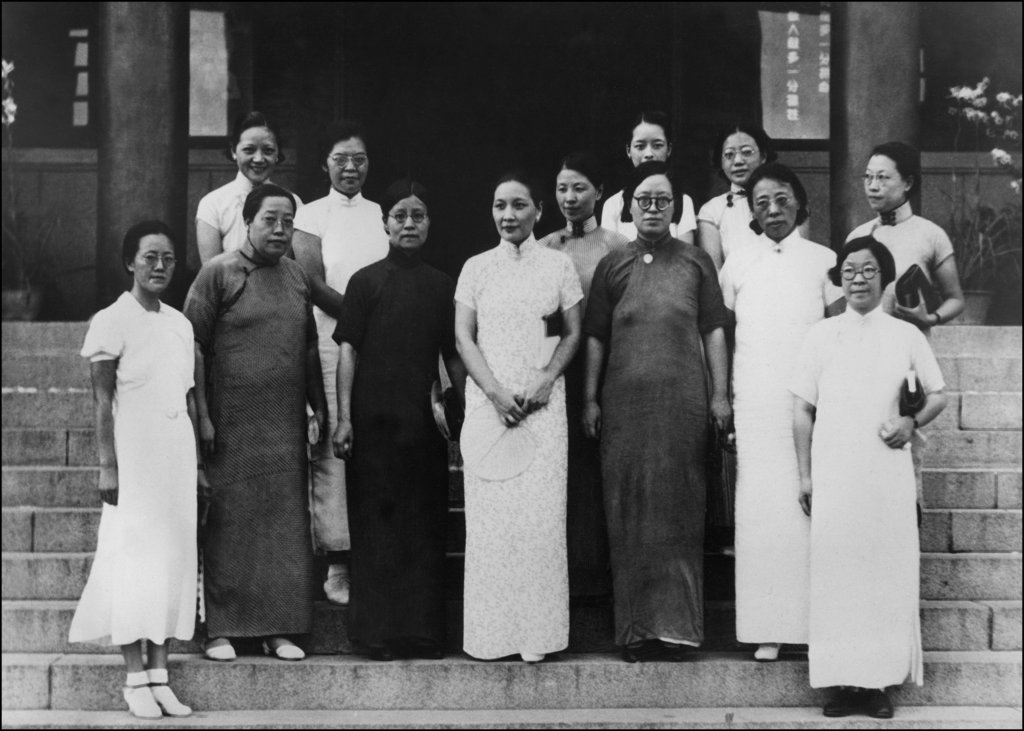
Sibu : Why Foochow ladies before 1980's wore Qipao


Women For Chinese Troops, 1937

My Chinese teachers in the 60's and 70's all wore the qipao or chieng yee. My Aunts from Singapore, when they came to visit, also wore the cheing yee and they looked so nice.

My grand aunt, Chang Yuk Ging, wore only the qipao every where she went. And I remember buying materials for her from KL. I asked her what kinds of materials would be good for her qipao. She only liked cotton.Image may contain: 6 people, people smiling, people standing, tree and outdoor

Sibu born Foochow women like my mother and aunts did not wear qipao.

The Cheongsam (Hong Kong Cantonese term) aka qipao (Mandarin) is believed to have evolved from a long robe worn by Manchu women during the Qing Dynasty. (1644-1911)

Before qipao became popular in China, Chinese women wore two piece outfits consisting of tops paired with either skirts or pants.

The earliest qipao were loosely fitted and had a low hemline that reached the ankle.s

It was known that the first group of Chinese female students wore the qipao in Shanghai in 1912, made of cotton, plain in design and loose fitting with bell sleeves. Looking like a modification of the man's long robe, the qipao was in a bid for gender equality. This experimental style of dress piqued the interest of other women and it soon became a trendy outfit.

Shanghai was the fashion capital of China and soon the qipao spread to other parts of the country especially when posters featured beautiful women dressed in qipao.

It was in the 1930's that the Singaporean Peranakan women in Singapore caught the qipao style It was often worn when women took graduation photos. Soon school teachers began wearing the qipao. And soon most working worken in Singapore and Malaya wore the qipao. in the 1950's and 60's.


Women For Chinese Troops, 1937

The Chongs and Tiongs Meet Up in Sibu

Yeah..I couldnt believe that the Chongs and Tiongs are meeting up in Sibu on 4th,5th and 6th Oct 2026!! Cousins from Australia, Singapore, ...