July 31, 2019

5 sisters attending Post War Yuk Ing Girls' School, Sibu

My Grandmother Wong passed away during the Japanese Occupation and it was a very tough time for the family.

It was hard for the girls especially. The eldest of the brood, aunty Heng Sieng was not willing to go back to school so she stayed home to do the chores and Grandfather said when a good and suitable suitor came along, he would marry her off.

7th aunt, chiew Sieng and 8th Aunt Pick Sieng were just teenagers themselves and they looked after the other 3 younger sisters. My fifth Uncle was soon to study in Singapore and 6th Uncle upon completing his junior high, would be leaving for Kuching to study in St. Thomas'

Grandfather arranged with Mrs Hoover and Mrs. Summers to have the 5 daughters board in the Yuk Ing Girls' School.
Image may contain: 4 people, people smiling
My 7th, 8th and 9th aunts, with their first cousin, Ik Sing in Sibu.

In this way my 7th aunt in her tender age of 16 was both mother and sister to the three younger ones, assisted by my 8th Aunt.

From then on, the siblings looked forward to going home during the holidays but they studied very hard at school. My 7th aunt was to be the first in the family to complete Junior High School in Methodist school in 1949 , after which she joined join my older aunts in Singapore where she completed her Senior Middle High School.

She was full of admiration for her younger brother Yu King, my 6th uncle, who was very bright. He was one of the few Foochow students who completed Junior High in Sibu, studying in both the Chinese and English session schools.

In those days, most parents could only afford to send their children to  Chinese schools. Only the very best (and also the wealthier ones) would study English in the afternoon session. I suppose in those days it was like doing a double degree with honours.

My 8th and 9th Aunts were very good, and they did the double session school. Later my 10th aunt went to St. Theresa in Kuching and was the top student in the whole of Sarawak for Cambridge Exam. My grandfather treated her like a Government Official who passed the highest Qing Dynasty Civil Exams or Jor Nguong when her results were know, and published in the newspapers.

Hus Hung Factory : Japanese checked all the records and record player

It was early during the Japanese Occupation when the Japanese soldiers started to search homes for evidence of anti Japanese elements.

After the chief mechanic was killed by the machine gun of the Japanese boats, the staff and the family members of the employees were terrified by any approaching motor boats, especially from across the river.

One day suddenly many soldiers came to the factory and started looking for evidence. They were rough and soon they found my father's record player and many classical music records. They also found lots of English books.

Since they belonged to my father, he was immediately arrested.

My great grandfather and grandfather were distraught. My father was beaten up  several times and not allowed to eat. But he would not confess that he was a British spy.

Image may contain: 3 people
It was quite a popular fashion for three generations of grandfather, father and son to take a studio photo together. This was before my father went to China to further his education.
My grandfather went around asking for help and he found Mr. Lu was was able to write Japanese. Mr. Lu wrote a very good petition letter on my grandfather's behalf, and he too vouched for my father's good behaviour.

My father was worried that the Japanese might find out that he had studied in Beijing. Luckily there was no graduation photo of my father in any of the rooms in the house or office.

After a traumatic ten day period the Japanese reluctantly relased my father.

My great grandfather and my grandfather were immediately at the Kempetai office to receive my father who was then quite weak from the 10 day remand. The three of them embraced each other and cried, thanking God for the mercies shown. My aunts all said that it was a grand day for the family in Hua Hong Factory.

They were so relieved that Big Brother was spared. A year later, in 1943 my great grandfather passed away. He never saw the end of the Japanese Occupation.

Hua Hung Ice Factory : GRandfather's Delima

My Grandfather who owned the Hua Hung Ice Factory and also three motor launches was forced to sell two of  motor launches to the Japanese.  He was too scared to refuse and he was flatly just given 300 Japanese dollars which was really below cost.

This is just a photo to show what kind of wooden motor launch my grandfather had. His was a double decker, and much smaller than this one. He had one for passengers and two for carrying goods and passengers.
Fearing the worst for his family, he moved all his children to Binatang where they could live further away from the Japanese soldiers and there was more food resources from the farm grandfather and his brother owned about 3 miles inland.

Grandfather was in luck because a Foochow man wanted to move away from Sibu and he was willing to accept the 300 Japanese dollars for his one land title. This man could have other land titles but my grandfather would never know. In later years this man probably made a lot of money upriver.

The land he bought with the Banana money was later on, more than half a century later actually was worth a few millions. My uncles, cousins and my grandmother protitted handsomely from the sale.

Many people believed that my grandfather was blessing his family long after he passed away in 1963.

Blessings from a far sighted father who did not want to waste any money but must have solid property. He was a very wise man.

The Sirat, the Kilt and the Suit

A few films have been made about Sarawak and the Dayaks.

Here is a photo of the Governor General of South East Asia, Malcolm MacDonold with Iban warriors in their sirat (Iban langauage) or cawat (Bahasa Malaysia). The hair style of the Dayaks has always been well cut, and well brushed, unlike some of the Hollywood portrayal of the Amazonians.
\


Image result for Sarawak Ibans in sirat Tun Jugah
This is a photo fo Tun Jugah meeting the Duke of Edinburgh in Sibu.


Image result for Sarawak Ibans in sirat Tun Jugah

Sarawakians all suited up....


Sibu Tales : From Jelutong to Rubber

Dyera costulata

Jelutong fruits.Jelutong leaves have the “terminalia” charateristics and the leaves are whitish on the underparts.
Jelutong leaves have the “terminalia” charateristics and the leaves are whitish on the underparts.


Also known as jelutong paya. 

Its cousin Dyera Costulata is found in the lowlands of Sarawak.
When the Foochow Pioneers first arrived in Sibu in 1901, they looked around the swamps of Sibu and were quite disappointed.

They had imagined a flat land like that of Min River valley and not a tropical swamp with floods, with mosquitoes, snakes and lots of insects. It was really quite a daunting task to grow padi to fulfill their agreement with the Rajah, to create a rice bowl.

They looked around for other alternatives. Their first alternative was what they saw in the jelutong tree, its latex which the Ibans could trade with. And it was an export commodity which could give a fairly good income.

The latex of this jelutong is an important ingredient of chewing gum.

It was hard for my grandfather who was a very young man then to look for jelutong trees, identify them properly and make the cuts to tap the latex, following the example of the Ibans. He met snakes, he got lost and it was really hard work.

A few years later James Hoover imported rubber seedlings and Wong King Huo was the first Foochow man to grow rubber. After that more and more Foochows and my grandfather started to clear land and grow rubber. My grandfather's first rubber garden was in Sg. Merah with about 10 acres, which he cleared as a very young man.

Rubber bands in Foochow dialect is still LOTONG dai , from jelutong. In proper Chinese, rubber band is Xu Jiau dai.Image result for rubber bands
Note : One of Sarawak’s earliest pieces of forestry legislation, the Forest Rules, regulated the method of tapping jelutong trees. The magnificent columnar jelutong tree can get as tall 60 metres and reach a diameter of two metres.

July 30, 2019

Small fish. Huge in Taste

Image may contain: food

We grew up eating a lot of fish as one of our uncles was a fisherman until his friend's boat shipwrecked. After that stint as fisherman, whenever he had free time, he would take his casting net out to the river side to catch fish.

One of our favourite fish was the small ikan kuning (Yellowtail scad) during our childhood

Small fish is troublesome to the busy housewife because she has to clean , process and spend time frying them. That is why my mother prefers the bigger fish. Cleaning the fish and cooking it would be easier.

Smaller fish is also not good for steaming.

And the best way to eat fresh fish is to get a big one and clean and steam, and the whole process would just take minutes!!

But to me and several of mylike minded friends, it is very uplifting to fry small fish and place them on the table for many people to share..eating with hands and exchanging stories in the evening.

So every now and then I would buy a lot of yellowtail scad and fry them...eating them together with friends is a walk down memory lane.

I would call that Happy Hours with Small Fish and Friends.

July 29, 2019

Beef and Radish Broth : A Foochow Dish

Image may contain: food

My father liked his beef and radish soup. Most probably because he lived in China (first in Shanghai and then Beijing for more than 8 years). As he was quite scholarly, my grandfather was only too happy to send him to college and then university in China, far away from Sibu. He probably left when he was lamost 18 or 19 as we never asked him about when he left for his studies.

Beef was readily available in Shanghai and Beijing before the Second World War. And now in the 21st century it is even more readily available. My father often talked about beef wrapped in pancakes and beef broth.

In our family we often had fresh beef broth with radish because he would come back happily with some fresh beef from the Malay butcher in the Central Market. Sibu in those days did not have beef in the market every day. So it was a big treat for us to have beef soup.

My mother liked to plant radish which we all liked. We could have stir fried radish, boiled radish or radish cooked with some chicken or pork. We also liked radish cooked with ikan bilis.

Beef broth or beef bone soup can be considered a delicacy for the Foochows.

Nowadays we have Korean and Japanese influence. We can easily use importted ingredients to cook our beef and radish soups.

The Many Uses of Sarong


A spring cot (sarong) is often a useful answer to let the baby sleep soundly for a long time.

If a father is busy looking after a shop he can safely put the baby to sleep and from time to time let the spring move up and down (according to the weight of the baby).Image may contain: 1 person, smiling, outdoor

There is also a new technology now which times the spring according to the needs of the baby.

the sarong cot or spring cot is a helpful Malaysian technology which helps many parents.

There are many pros and cons regarding the use of the spring cot. Some parents refuse to use it, while some grandmothers swear on it.

It is really up to the parents to decide whether to use it or not.

The truth is some babies just sleep very well while some babies are just very difficult.

Sibu: An Area called River Head

A church at the Head of a River. Kerng Tau, Giu Chuo Tong, The Saviour Church

No photo description available.

Kerng Tau was quite a special place for me. Its name was special and the geographical area was unusual. It was a place where my grandfather would mention quite often as we visited him.

This church was established in 1935 together with a school. This old photo was taken in 1937, the year my father came back from Beijing. In the olden days, my grandfather and my relatives called this area Kern Tao, meaning the beginning of the river. I am so glad that there is a lady sitting in the front in this photo.

The committee members in those days were : Hii Hock Kang, Ting Chew Hin, Hii Ming Teng, Wong Siong Kee,Ling Ching Tiang, Sia Tung Kiong, Lau Tieu Peng, Yii Tiong Jang etc. The committee worked hard to seek donations and together the community built the church and the Nang Sang Primary School (which today is a large school).

In the 1930's most of the Foochows were rubber tappers, many of them were new arrivals. the land here was much better than the swampy Rajang valley but nevertheless, floods occured very frequently too.

It was normal for every one to walk all the way from Sungei Merah to Kern Tao village, and to visit and worship together in this church. Their faith was strong and they worshipped fervently.

My grandfather's best friend, Rev Ho Siew Liong in the 60's  was in charge of this church for a while. When I visited my grandparents in those days, I would worship in Sing Ang Tong and enjoyed Rev Ho's sermons in Foochow. In the afternoons I would watch youths play basketball in the church yard. Mrs. Ho was a Foochow speaking lady with a very strong Heng Hua accent. And there would be some youth from Kerng Tau playing basketball too.

This wooden church was demolished and a new church was dedicated in 1964.

Thirty years later, in 1998 a very grand church was  built because of urban sprawl in Sibu. The expansion in housing due to expansion in population created a huge boom in the construction industry.

The Methodeist churches in Sibu redeveloped by leaps and bounds.

Now this area is known as Ulu Sg Merah with lots of shop houses, offices, new homes, new schools etc. There is a huge government school called SMK Ulu Sg Merah here.

Kerng Tau or Ulu Sg. Merah is a very thriving suburban centre today with good roads,shopping malls and other utilities. there are lots of millionaires here who have benefitted from the investments of their Foochow grandparents who came with Wong Nai Siong, and later years.


Image may contain: sky, house and outdoor

A church can be a keeper of historical records and an icon with lots of stories to tell.

July 28, 2019

My Grandmother Chong's relatives Visiting us in Sibu

Image may contain: 7 people

We lived in 9 Brooke Drive, Bangunan Takang, from 1978 to 1990's and that was an easy place to visit, within walking distance from the Rajang Tua Pek Kong Wharf, and the Sibu town itself.

The flats had a good parking lot which was free of charge and many people could park easily there.

Besides we had neighbours all around who had been living as our neighbours for more than 50 years! Those who had prospoered moved away to better homes, or moved overseas like Mary Cheng and her mother.

The Heu family had also moved away. And so did the noodle making family the Tings. (Ah Chuo Pak and Ah Chuo Moo).

We continued to receive relatives from Sg. Bidut, Bintangor, 24 acres and Sg. Merah.

One of the best events we had was a visit from my father's mother's relatives, the Chongs who came back for a visit. They are daughters of our Aunty Java (Chong)

They were all Java born but migrated to Australia in the 60's. Those were the days before Whatsapp and the internet.

But it was a most significant visit for my mother and for my Chong relatives too, Aunty (Biu Goo) Chong Eng and Aunty (Biu Ring) Meng Toh (Mrs. Chong Chung Sing).

My mother as usually had a chicken ready to cook chicken soup and mee sua to welcome them.

My Chong Grandmother's ancestors had come from Fuqing, Fujian. They are knowns as Hook Chiang Nerng (a large group migrated to Sitiawan in 1904)and we are Ming Chiang Nerng.

Having a photo taken at a balcony was often done because of better lighting. This is a rare group photo of descendants of my great grand father Chong Khim Swee . My Great Grandmother was of the Ngieng Family. They had first migrated to Java and then later Singapore. When my grandmother Chong and her brother Chong Jin Bok was engaged by Rev James Hoover as Head of English for the Anglo Chinese School for boys made Sibu their permanent home, our Great Grandparents came to live in Sibu.


July 26, 2019

My Late Father in New Straits Time.

Image may contain: 1 person


Image may contain: 4 people

Chang Ta Kang : Canada 1962

In 1962 my father was the sole representative from Sarawak to attend the Commonwealth Conference in Canada.
It gave him the opportunities to visit industries and local communities. And to meet other representatives from the Commonwealth.


Image may contain: one or more people
The Commonwealth Study Conference was first organized in 1956 with the active support of H.R.H. The Duke of Edinburgh to study the human consequences of industrialization. They were held every six years in different countries.

Prince Philip stated: "The conference is purely intended to influence those who attend it in such a way that when they get to a position of authority, the decisions that they make will be based on a reasonable understanding of the consequences. Remember what I said earlier-that these are men and women on the threshold of executive appointment."

RED EGGS : Foochow Culture

Image may contain: food

My father married my mother when he was 40 years old. It was still a much expected thing for a man, to have a son. And it was especially stressful for my mother because my father was considered quite old already. The burden was heavy for my mother , as she was Chinese educated, conservative and obedient.

She followed Confucian teachings and the her extended family, the Laus, were full of expectations of her. Besides she was married into a huge family with an outstanding patriarch.

Her sisters in law, who had married into the large family earlier, had already produced several boys who were running around. Each time a baby boy was born into the large extended family, red eggs were distributed.

And the catch phrase then was,"Soon we would have red eggs to eat" whenever a relative was pregnant.

It was a trifle sad on the part of my mother because she felt pressured. She was still under 30 years of age and there were no experts were around to guide her. She had no methods  to help her conceive a boy.

Was she to resign to the fact that she could not make RED eggs for relatives? She had given birth to two girls and for their birth she could only make simple plian hard boiled eggs. Each year their birthdays were celebrated with plain hard boiled eggs.

When she had her third preganancy every one was curious. Her female relatives started to anxiously ask, "Do you feel different?" "Do you feel like eating something different?"

My maternal grandmother started looking at the gender of the chickens she was getting ready for my mother's confinement. A tell tale sign was the number of males and females in the chicken reared for confinement. Were there more females in the brood? That would mean she would have a boy.

So for 9 months every one waited with great expectations.

When she gave birth to my brother Hsiung, everything changed for her. Her spirits were uplifted and my father who was then almost 45 years old was a really happy man. He finally had a boy child and my grandfather came every day, by motor launch, across the Rajang, to see his new born grandson. He was truly over the moon, watching the squrmy little with that extra little flesh which helped put my mother on a higher status.

More relatives came with chickens and eggs and look at the pretty little baby boy for the whole confinment month. My maternal grandmother was beaming with happiness and she told every one that every day she had to make so many batches of noodes (soh mien), kill so many chickens and boil so many RED EGGS.

My mother thus had a chance to give out red eggs.

Making Red Eggs : the eggs are first hard boiled and then red colouring (either powder or liquid form)  is applied. A basin is filled with the red colouring and the hard boiled eggs are put into it. Sometimes 100 red eggs are made for distribution to guests who come from near and far.

It is common to hold the baby boy's full month with a red egg and mee sua party, and for some families, it was a full banquet in a hotel or restaurant.

The red eggs can be distributed to the guests, or later, as a take home gift.


July 25, 2019

Bank Road, Sibu

Image may contain: sky, tree, car and outdoor

Related image
A gem found on Google.
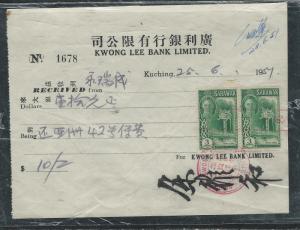
The Bank Road has a special place in history of Sibu. First it was the address of the first bank in Sibu, the Kwong Lee Bank which was established in 1932. Kwong Lee bank was also a Sarawakian family Bank.

Besides, the first Rubber Middle Man, Wong Sing Kheng also established his first trading shop at his own shop lot at Bank Road. Called Hock Chiong, this import and export business was established because of the growth of rubber exports from1910 until very recently. The Wong Family owned the business for almost a century.

During the Japanese Occupation, the Bank Road was also the centre of Japanese Army activities as the Kempetai established itself in a few of the shop lots and the Borneo Company Building, which faced the Rajang River.

An aunt of mine who was a boarding student at the Yuk Ing Girls School (next to the Masland Church said that she was petrified of the Japanese soldiers who walked from Bank Road to the Island Road and then to the Lau King Howe Hospital on their patrol. She also told us that the bomb craters (created by the Japanese bombs) at the back of the Masland church were filled with water  when it rained. And the local people took the water for drinking and cooking.

The Yuk Ing girl students were asked to go home after 1942 as no one could protect them any more from the soldiers.

Some people were actually shot to death on the road.

There was actually a small island or rather roundabout made from a deisel drum standing in the middle of the cross road and a traffic police would stand on it to direct traffic in the 60's.

Wharf labourers continued to line up the Bank Road, the Wharf Road for a long time as these two roads are the nearest to the go down and the wharf.

July 24, 2019

Chang Ta Kang : Sending Siblings Off at Sibu Airport

My father was always at my grandfather's beck and call, as a very obedient son from young. A first cousin of his had given such a remark when she came to our house to wail at my father's funera.

Aunt Li Sieng, who married Lau Tiing Ming was a good relative and a good first cousin. She often came to see my father for advice. And we also called her Dui Goo or first aunt, even though we also had a Dui Goo, my father's own sister, Lily.

From Aunt Li Sieng, we learned a lot about my father being mild tempered, obedient, easy to get along with. He was always the one Grandpa would call to run errands and do things. And he seldom made mistakes, which made Grandpa very happy. Perhaps that was the reason why Grand father would call him to do stuff and not the other siblings. Besides my father would also be by the side of Grandpa and Grandma when things needed to be done.

When my father graduated from YenChing Univesity and had a good camera, my grandfather was very happy with that. Therefore his duty was to photograph every event my grandfather was in at the Sibu Airport, especially.

Sending off relatives at the Sibu old airport was a mjaor family event. Grandfather liked to see all the children all dressed up, with socks even. He himself would be wearing a neck tie.

...

Image may contain: one or more people and people standing

Sometimes my father would not be in the photo because the backup photographer, Uncle Lau Pang Kwong, or Cousin Tony Tiong was not around.

These family events were lovely and I was really happy to see my aunts and uncles.

Such an occasion was great for our family to show our solidarity.

This photo at the airport was really a memorable photo because Grandpa had just celebrated his 70th birthday and a few years later he passed away.

July 23, 2019

Foochow Rattan Basket

Image may contain: one or more people, motorcycle and outdoor

Most first and second generation Foochows (1901-1970) made their own basket from rattan or bamboo, with the skills they brought from China. My own grandfather was able to make good baskets from recycled materials.

this "Foochow Basket" was ubiquitous in Sibu. My Malay school mates used to call them Bakul Cina. And they would use that to identify the race of the person carrying one.

A friendly nurse used to say that the basket was very useful. When she saw an old lady carrying one, with hot water flask, a bottle (for medicine, when no bottles were supplied by the Lau King Howe Hospital, and patients had to bring their own), a bottle of aerated water and a paper umbrella, she would immediately know that she would be a Foochow lady from down river. She would then switch to broken Malay to speak to her.

I liked her sense of linguistic appropriacy, and she was able to code switch, to "lower herself" to be understood.

This photo shows our beloved school gardener, Wong Cheng Hiong who was a most pleasant and helpful Foochow gardener. His wife worked as a housekeeper for our principal, Mr. Wiltshire and his family.

Sometimes his wife would cycle all the way from Sg. Aup to work, sometimes, he would give his wife a ride on his motor bike. Cycling 3 or 5 miles to work or school in those days WAS A NORMAL ACTIVITY.

He was a man with a Foochow rattan basket. Clasp at the back of his bike the basket was a hold all and it was so useful to bring stuff from town to home, or from home to town.

This was before the days of plastic bags or a fibre glass box for the motor cycle.

(A rattan basket like this in those days would be abo0ut 3 or 4 dollars, considered quite expensive.)

July 22, 2019

Chang Ta Kang : On the Road to Sg. Aup 1950-1960

My father was in a way quite a special parent.

When he worked in the bank, he brought us to see where he worked, and introduced us to those in the office. He seemed to enjoy having us around him and his friends. Thus I was quite often by his side when he played mahjong at the Sibu Recreation Club.

When my grandfather pulled him out of the Hock Hua bank to help start the Kiong Ann Brickworks, my father continued to bring us work whenever we were able to go with him as Sg. Aup was quite far away from Sibu.

The Kiong Ann Brickworks was very important for my Grandfather who from then on was known as the First Foochow in Sarawak to make bricks using imported (British) machinery.

The Kiong Ang Brickworks saw the first conveyor belt machinery to bring mud into a churn to make bricks. I remember I was told that this was the first mechanized brick making factory in Sarawak. It was also reported in the Sarawak Gazette. And the bricks were labelled K.A.B.with the help of a simple label machine.

My father had gone to Singapore to help my grandfather order the machinery.
Related image

Most of the workers were the Ibans who lived in the surrounding longhouses in Aup, while some were itinerant workers from Kapit and elsewhere. My grandfather built sturdy wooden hostels for them. Many young girls were employed to stamp the KAB on the bricks and to dry them in the sun before they were burnt in the three huge kilns. Every week the brickworks produced more than 5000 bricks and they were all snapped up by the local builders.

The Brickworks had its own electricity and water supply. My grandfather who was a good engineer had all these planned and implemented and the employees were very happy working under him.

No photo description available.

The brickyard office was actually the living room of the manager's house which was really well furnished. There was a gun, which was displayed in the cupboard in the office. We kids were told that the gun in the cupboard was a kind of deterrent and by word of mouth, the manager was protected by a gun!! That was nice to know that my father was safe in the "wild outback". A guard also had the use of a gun.

Once my father finished work, whenever he brought my siblings to work, he would bring us in the Landrover home. The slow drive home would take about an hour. Sometimes the countryside road was in very bad conditions and we were worried the brakes would malfunction. But father was a good and careful driver.

However I remember the few times my father would stop at an aunt's house at the junction of Sg. Teku and Sg. Aup road. Aunty (Mrs. Song) would make Milo Egg Nog for all of us. I believe my father really enjoyed that. But we kids did not like the eggy drink. Father would tell his cousin to make only two glasses. One for him and one for the kids to share.

My father was to later become the match maker for aunty's second daughter. He introduced Mr. Borneo Hardware Wong, who had a shop in Central Road, Sibu, to his niece.

A few years later, my father had a quarry licence to operate the Takang Quarry in Sg. Aup, quite near the Kiong Ang Brickworks. That's another first for a Foochow - to use dynamite to quarry granite.

July 21, 2019

Chang Ta Kang : Sports in Yenching University 1934-1937

When he enrolled in Yenching University he was considered a slightly older student but many of his course mates were also more or less of the same age.

According to an aunt, my father and my two other uncles studied for a few years in Shanghai to brush up their Chinese and a few other subjects. Their education in Sibu was considered Junior Middle School Education.

The First World War and the general economc depression had created chaos in China and the world. Many of the undergrads had to work for several years before applying for places at the university.

Needless to say the Nanyang Chinese were also affected by the world depression.

However most students from Nanyang did enjoy the special education offered by Yenching University. My father paid the minimal fees as he was a "recommended student" from a "missionary settlement of Sibu". Rev. James Hoover, my grandfather and Lau Kah Tii, the Foochow Kapitan, were delighted by the academic opportunities and the remission of fees for Nanyang students.

My father, being from equatorial Sarawak, was in awe of Ice Hockey. He related to us , his children that when the opportunity came, that was the one game he took up quite seriously. However he would not ski if he could help it, although many of his friends took up the sport. Most of his course mates from the northern part of China could skii well. He thought that skiing was a very dangerous game.
No photo description available.
 He liked the winters of Beijing and would often tell us stories of his escapades in the city, looking for roasted hot chestnuts.

In later years in Sibu, he would request my maternal grandmother to put exptra chestnuts in his zonghzi, or nik chern which my grandmother would most be happy to do so. Chestnuts give zhonzi a natgural sweetness.

Thus for his sports during his undergrad days, ice hockey was the game my father enjoyed for a few years.Image may contain: one or more peopleImage may contain: one or more people

He used to tell us that he would also swim but he did not take part in any swimming competitions.
Image may contain: one or more people
He enjoyed some tennis but he also did not take part in any competitions. In later years he did play some tennis in Sibu, but he found that he was getting too unfit in his 40's.

July 20, 2019

Soh Mien Kuih (Longevity Noodles Savoury Pudding)

It is quite often we had left over soh mien and my maternal grandmother would just mix the noodles with some ingredients to make a pudding. In later years we found out that many women wrote about their recipes for this special pudding.

The pudding is quite simple to make actually. But you do need a good kuali for steaming and a big pan for shallow frying.
Image may contain: foodImage may contain: 3 people, people eating, food and indoor

Sibu's Borneo Cultural Festival 2019 saw a lot of visitors and as a Foochow, I zoomed into the Foochow Association Stall ...and watched the making of the soh Mien Kuih.

You can use the following aromatics - some chopped garlic, and shallots. a few slices of finely chopped mushrooms. equal amounts of minced pork and prawns. Fry them together using sesame oil.

Add to the cooked soh mien with chicken stock, some chopped spring onions, sugar and salt to taste.

Put together the soh mien and the fried ingredients in  a greased tin and refrigerate...When ready to eat the pudding, take out and cut into nice portions.

Fry in egg batter like in the second photo.

Photos taken on 18th July 2019

July 19, 2019

My Family and the Rajah Brooke


When my sister was born, the traditional midwife was very observant and she immediately told my mum that the baby had a bad eye.

That really worried my parents no end. But we had a good childhood in Pulau Kerto.

When we moved to Sibu, my father decided that my sister required an eye surgery before she went to Primary One. So my father took her to Singapore and they sailed on the Rajah Brooke, second class.

Today more than 60 years later she remembers leaving Sibu and sailing through quite a calm South China Sea. They arrived at the Keppel Pier where they alighted. She cannot remember what food they had because she stayed in the cabin most of the time as she was quite scared. She was just a little under 6 years of age.

Father took her to the hospital (it must be the only one then) with aunt Lily's help. She was a little too young for the surgery and the specialist recommended the corrective surgery to be done when she was older. She was fitted with a pair of corrective glasses, which she also stopped wearing after a year or so as they did not really help her.

They then came back to Sibu and then not long after that our father passed away quite untimely.

She never had her eye surgery. But she went on to be a great scholar, became a trained teacher. Today she still has her eye problem but no one ever noticed it. She remains our most observant sibling.

No one should really cross her as she can "see through everything"!! Perhaps God has blessed her with extra sensory powers.

July 18, 2019

Autograph Books

Image may contain: 1 person, smilingImage may contain: 2 people, people standing and outdoor

1969 - I was temporary teacher at the Methodist Secondary School, after my 6th form, my sister and Grace Wiltshire were in Primary Five Class Methodist Primary School.

Everyone in their class started an autograph book for friends to pen a few words.

Grace wanted to bring hers back to the UK as the family was going home after a 10 year mission work in Sibu.

50 years later in 2019, Grace came back to Sarawak to see friends and she brought along her autograph book.

Amazing memories, impressive keepsake.

The John Ting, son of the then Chairman Board of Directors of the School , Temenggong Ting Lik Hung, is now holding the same position. He is a person who loves books, and he loves autograph books. "My sisters collected authographs, but I didn't. I am jealous of my sisters."

Mr. John Ting feted the group to a very sumptious Chinese Luncheon at MPI canteen on 18th July 2019.


July 17, 2019

Peach Gum

Peach gum is the resin from peach and Chinese wild peach trees.

In recent years, peach gum or peach resin has become a very popular sweet dessert in restaurants.

It is served together with white fungus, red dates, barley and even sago pearls in cold syrupy soup after a huge banquet.

The amber hued coloured gum is also called "the tears of peach blossom" . People like it a lot because it contains a lot of collagen.

Image may contain: food

Photo above : This is just a small packet of loose peach gum I bought to make my sweet dessert at home costing about 3.00 ringgit from a supermarket.

Peach gum is the resin from peach and Chinese wild peach trees, already solidified when it is found. As detailed in classical Chinese medical literature, its curative qualities include solving urinal infections, thirst-quenching and relieving stress. 


Epitaph for Grandmother

 My grandfather Tiong Kung Ping was over wrought when my Grandmother chong passed away at a young age of 38, from hemorrhaging caused by a miscarriage.


Grandfather asked Rev Yao shiao King to write the epitaph in Chinese for her "funeral porcelain photo" a norm at that time. The photo is rather faded and the characters are not so clear, but definitely the calligraphy belonged to Rev Yao Shiao King, my grandfather's best friend.

Recently my friend How K Hwong helped me explain the words (the epitaph of my grandmother).

名門閨秀 [淑?]慧蜚聲
桃夭早X 伉儷篤情
蟹文共賞 相夫成名
克家有子 群秀爭榮
郝鍾美德 [?]母勤明
古之賢媍 直可抗衡
仰瞻懿範 女界典型
揚芬彤管 [雖][?]猶生

My grandmother had come from an eminent family, Chong family, with sister who was educated in English and a brother who was also educated in English in Singapore. Great Grandfather Chong Swee Ging /Kheng was originally a pioneer from Fuqing who settled down in Java for a while,and later they moved to Singapore and finally to Sibu. (There may be some inaccuracies here)

I like the way my friend also said that the first four words also meant that my grandmother was a graceful young lady of talent and virtue who hailed from a eminent family. So befitting!!

July 16, 2019

Seaweed Hung Ngang


Each time I come back to Sibu I must eat a lot of Foochow food, which I miss in Miri.

I would order die bian, dian miang ngu, soh mien, etc.

This time I was at a new shop called LIM TEH by the bank of the Igan River.

One of the stall owners introduced her sea weed hung ngang to me. And I quickly said yes to the suggestion.

I love sea weed and I was not let down. She put so many good things into the soup for me as a special treat.

I was like a "daughter coming home to mother". The stall owner understood. And I was so touched.
That is the kind of welcome Sibu hawkers would give to Sibu people who have lived away from home.....

16th July 2019

July 15, 2019

Fuzhou : Hot Buns with Vegetable Fillings

No photo description available.

My friend in Sibu asked me about a photo I took some time ago in Fuzhou.

This is a special Savoury Bian served at a Fuzhou City banquet. It is a vegetarian bun for those who are vegetarians.

As it is a vegetable bun, the menu names it Chay bian , just vegetable biscuit.

Interestingly the pastry is not so easy to make according to our hostess.

It is not the Shanghai pastry, nor is it bao pastry. It is quite solid and heavy. May be one day we will find the recipe .....

July 14, 2019

Fresh Betel Nut

No photo description available.

The areca nut is the fruit of the areca palm, which is commonly found in Sarawak and most of South East Asia.

It is commonly known and according to some people it is a misnomer, as the betel nut. Many people consider eating this nut harmful to the body.

Eating the slices of the nut is considered a good past time besides being a social activity. The nut is usually sliced into thin slices by a very sharp and special cutter called kacip. The slices are wrapped in a kapur (lime paste) smeared betel leaf and chewed for a long time. Many women like to keep the betel leaf and nut in their mouth for a long time. Some men think that this also keeps their women from talking too much.

But on the other hand, the chewing of betel nut and sirih leaves result in red gums and bad teeth!!

The eating of this composition seems to give a mild stimulant. In the past Indian coolies used to chew the betel nut to say alert at their work.

Malay culture and tradition hold betel nut and leaves in high esteem. Related imageTraditionally, guests who visit a Malay house are presented with a tray of areca nuts and betel leaves, in much the same way as drinks are offered to guests in many cultures around the world. There is even a Malay proverb about the betel nut, "bagaikan pinang dibelah dua", loosely translated like a betel nut cut in two, usually used in the context of wedding to illustrate how perfectly matched the bride and the groom are. (Wikipedia)

July 13, 2019

Sarawak : Tampoi

No photo description available.
It is very exciting to find a tampoi tree all of a sudden in the jungle.


No photo description available.
Unusual red flesh and extremenly sweet. The seedling came from a Bidayuh farm in Kuching.


No photo description available.

The tampoi Baccaurea macrocarpa,  is a good fruit. Some varieties are very sweet. It is found in South East Asia and especially in Borneo.

The female trees bear fruits on the brnaches like fig trees. There is no season for its fruiting so hunters find it very exciting when they come across a fruiting tree in their journey. The fruits are harvested and taken home to be shared.

Usually found in the wild in Sarawak,or planted by indigenous farmers, the fruits are usually harvested and sold in the native tamu. They are very refreshing and have high levels of antioxidants.

Interestingly the fruit skin can vary from red to yellow. On this tree, a rare but good variety, are small fruits with red flesh inside. Some fruits have have flesh.

For those who brew wines, this fruit makes excellent wine.


July 12, 2019

Engkabang Oil (Ilipenut oil) 2019

No photo description available.
My own photo of perhaps one of the last fruits from Bekenu 1990's during one of my outings with my children to be near nature.
In the olden days, the illipenut was the fruit which provided the Ibans with cooking oil. Today the tree is on the endangered list due to over logging.

The engkabang tree does not fruit regularly and in fact it is considered a temperamental tree. Usually it fruits only once in eight or nine years. Many scientists have tried to regulate its flowering and fruiting.

In Sibu there were a few Foochow men who became extremely rich in the 60's from the engkabang fruits. They were called Kings of the Chiu Ji (Kings of the Tree Seeds) and exported the seeds(very smelly raw exports)through Sibu-Singapore cargo ships. When the engkabang fruits arrived from Kapit and Kanowit, the wharf labourers and the Chinese towkays were most busy especially along the Channel Road, Pulau Babi, and the Wharf Road. One of the Foochow Kings of Engkabang was Sia Kie Ming of High Street, Sibu, and he was married to my 7th Aunt.


Image may contain: food
Photo by Mahmud Yussup with thanks. Raw Engkabang
Image may contain: food
A stick of engkabang (now can cost up to 15 ringgit for this tiny piece). The hardened engkabang is like tree butter and goes well with hot rice.
While the engkabang was famous as a forest product useful in the making of chocolates, lipsticks and other industrial product, back home in Sarawak, it was a traditional cooking oil. Today it is no longer an important export from Sarawak.

Furthermore oil palm has taken over the landscape and manufactured cooking oil can be easily bought in the supermarket.

The Illipenut or engkabang oil is now considered a delicacy among the Ibans who continue to process some for their own home consumption. But 2019 is a good year for engkabang oil producers.

The oil is used to enhance the taste of hot rice. It takes a few days to process engkabang oil and to harden it in bamboo tubes.

The whole of Sarawak, it might be an exaggeration, is very excited about the extra fruiting of the engkabang this year. Lots of the fruits could be found in the jungle (for free) and the Ibans in Kanowit, Pakan and some smaller areas are having a windfall.

Ferry - Labuan - Limbang - Lawas

  In 1974 I started my teaching career in SMK Limbang. I had completed my degree and diploma of education in 1973. When I asked for a postin...